



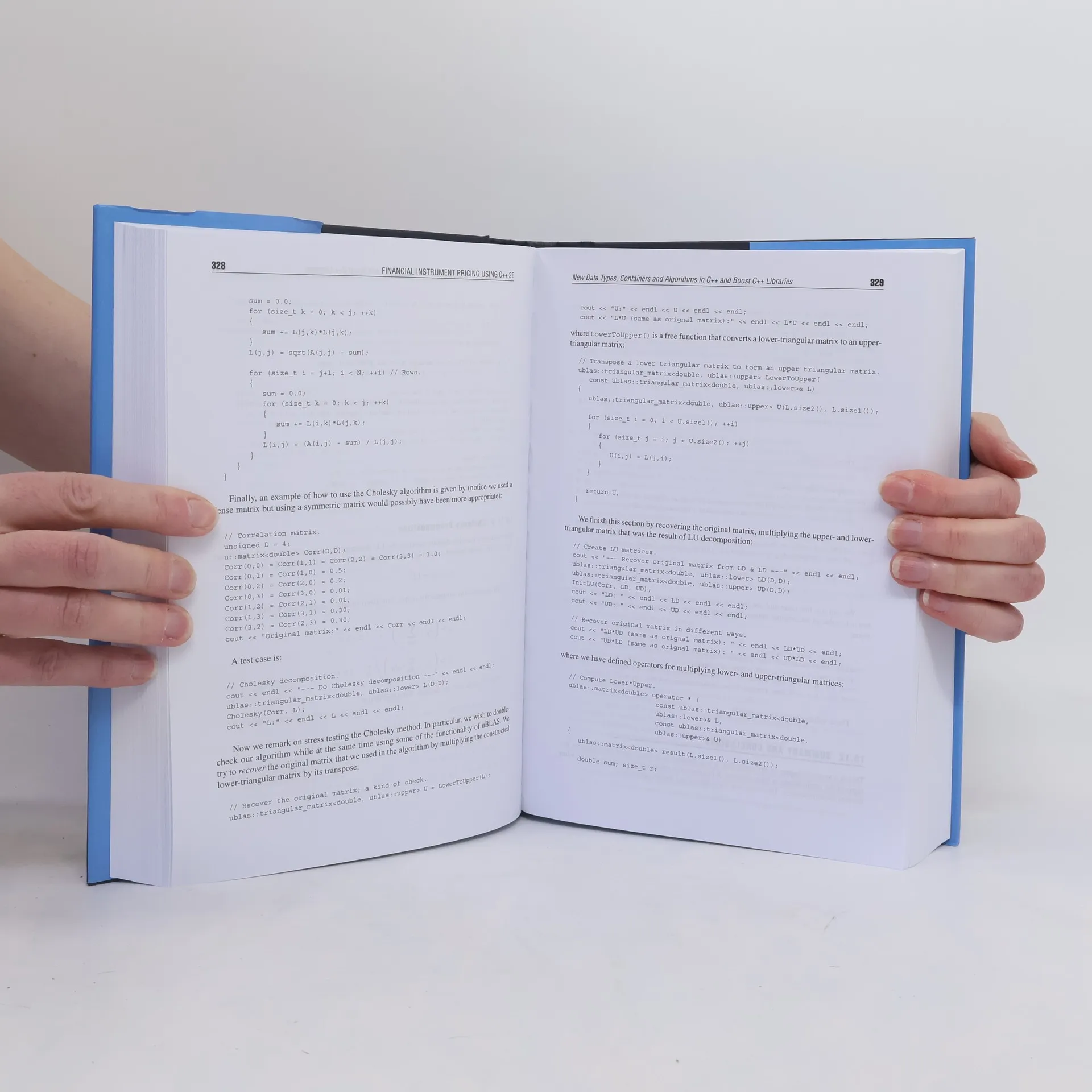
Więcej o książce
This comprehensive guide covers essential topics in C++ and its applications, starting with fundamental concepts and moving to advanced areas such as template programming and multiparadigm design. It explores the use of tuples and type traits, alongside advanced lambdas, while also delving into numerics, including IEEE754 standards and boost C++ multiprecision. The text introduces unified software design (USD) and discusses new data types, containers, and algorithms within C++ and boost libraries. Key topics include lattice models, their fundamental data structures, and applications in computational finance, as well as numerical linear algebra with a focus on tridiagonal systems. Data visualization techniques in Excel, univariate and bivariate statistical distributions, and STL algorithms are thoroughly examined. The book also addresses optimization, nonlinear equations, and the finite difference method for PDEs, providing a mathematical background. A software framework for one-factor option models is presented, including extensions and a PDE framework in C++11 for path-dependent options. It covers ordinary differential equations and their numerical approximations, advanced methods, and random number generation. Concurrency in C++ is discussed in two parts, focusing on threads and tasks, along with parallel patterns language (PPL). Monte Carlo simulation techniques are explored in detail. The guide concludes with a bibliogra
Zakup książki
Financial Instrument Pricing Using C++ 2e, Daniel J. Duffy
- Język

- Rok wydania
- 2018
- Oprawa
- (twarda)
Metody płatności
Nikt jeszcze nie ocenił.
- Tytuł
- Financial Instrument Pricing Using C++ 2e
- Język
- angielski
- Autorzy
- Daniel J. Duffy
- Wydawca
- WILEY
- Rok wydania
- 2018
- Oprawa
- twarda
- Liczba stron
- 1168
- ISBN10
- 0470971193
- ISBN13
- 9780470971192
- Seria
- Tagi
- Opis
- This comprehensive guide covers essential topics in C++ and its applications, starting with fundamental concepts and moving to advanced areas such as template programming and multiparadigm design. It explores the use of tuples and type traits, alongside advanced lambdas, while also delving into numerics, including IEEE754 standards and boost C++ multiprecision. The text introduces unified software design (USD) and discusses new data types, containers, and algorithms within C++ and boost libraries. Key topics include lattice models, their fundamental data structures, and applications in computational finance, as well as numerical linear algebra with a focus on tridiagonal systems. Data visualization techniques in Excel, univariate and bivariate statistical distributions, and STL algorithms are thoroughly examined. The book also addresses optimization, nonlinear equations, and the finite difference method for PDEs, providing a mathematical background. A software framework for one-factor option models is presented, including extensions and a PDE framework in C++11 for path-dependent options. It covers ordinary differential equations and their numerical approximations, advanced methods, and random number generation. Concurrency in C++ is discussed in two parts, focusing on threads and tasks, along with parallel patterns language (PPL). Monte Carlo simulation techniques are explored in detail. The guide concludes with a bibliogra