



Parametry
- 550 stron
- 20 godzin czytania
Więcej o książce
The content covers a range of advanced methodologies and tools in the field of computational biology and bioinformatics. It includes techniques for querying protein interaction networks, aligning these networks through neighborhood topology, and reconstructing protein complex topologies. The concept of "Network Legos" is introduced as a means to build cellular wiring diagrams. Methods for dynamic analysis of gene regulatory networks and in silico gene perturbation experiments are discussed, along with a feature-based approach to modeling protein-DNA interactions. The annotation also highlights network motif discovery through subgraph enumeration and symmetry-breaking, and the enhancement of de novo motif discovery using nucleosome occupancy information. It presents frameworks for identifying DNA copy number aberrations and estimating genome-wide copy numbers with allele-specific mixture models. Statistical methods for analyzing whole-genome array CGH data are introduced, as well as new approximation methods for simulating enzymatic reactions. Further topics include learning MHC II-peptide binding, reconstructing phylogenies of mobile elements, and developing heuristics for gene-duplication problems. It discusses tools for RNA folding kinetics simulation, multiple sequence alignment techniques, and connectedness profiles in protein networks for gene expression analysis. A Bayesian model linking microarray and mass spectrometr
Zakup książki
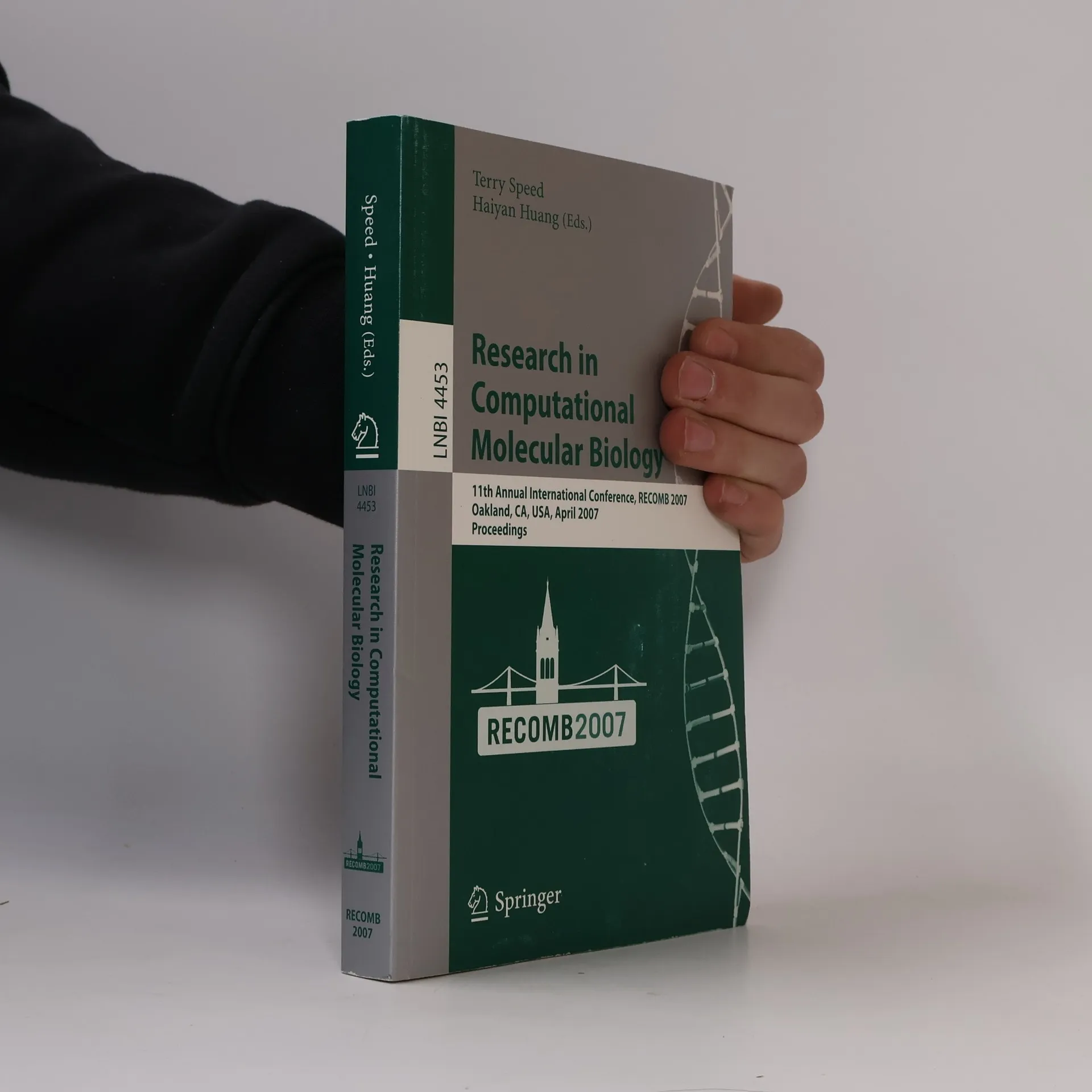
Research in Computational Molecular Biology, Terence Terry Speed, Haiyan Huang
- Język

- Rok wydania
- 2007
- Oprawa
- (miękka)
Metody płatności
Brakuje nam tutaj Twojej recenzji.
- Tytuł
- Research in Computational Molecular Biology
- Język
- angielski
- Autorzy
- Terence Terry Speed, Haiyan Huang
- Wydawca
- Springer
- Rok wydania
- 2007
- Oprawa
- miękka
- Liczba stron
- 550
- ISBN10
- 3540716807
- ISBN13
- 9783540716808
- Seria
- Kategorie
- Tagi
- Podręczniki, Nauki przyrodnicze, Podręczniki akademickie, Nauka, Podręczniki biologii, Sztuczna inteligencja, Biochemia, Bazy danych, Algorytmy, Biologia molekularna, Transkrypcja
- Ocena
- 2 z 5
- Opis
- The content covers a range of advanced methodologies and tools in the field of computational biology and bioinformatics. It includes techniques for querying protein interaction networks, aligning these networks through neighborhood topology, and reconstructing protein complex topologies. The concept of "Network Legos" is introduced as a means to build cellular wiring diagrams. Methods for dynamic analysis of gene regulatory networks and in silico gene perturbation experiments are discussed, along with a feature-based approach to modeling protein-DNA interactions. The annotation also highlights network motif discovery through subgraph enumeration and symmetry-breaking, and the enhancement of de novo motif discovery using nucleosome occupancy information. It presents frameworks for identifying DNA copy number aberrations and estimating genome-wide copy numbers with allele-specific mixture models. Statistical methods for analyzing whole-genome array CGH data are introduced, as well as new approximation methods for simulating enzymatic reactions. Further topics include learning MHC II-peptide binding, reconstructing phylogenies of mobile elements, and developing heuristics for gene-duplication problems. It discusses tools for RNA folding kinetics simulation, multiple sequence alignment techniques, and connectedness profiles in protein networks for gene expression analysis. A Bayesian model linking microarray and mass spectrometr