



Seria
Więcej o książce
A concise but rigorous treatment of variational techniques, focussing primarily on Lagrangian and Hamiltonian systems, this book is ideal for physics, engineering and mathematics students. The book begins by applying Lagrange's equations to a number of mechanical systems. It introduces the concepts of generalized coordinates and generalized momentum. Following this the book turns to the calculus of variations to derive the Euler-Lagrange equations. It introduces Hamilton's principle and uses this throughout the book to derive further results. The Hamiltonian, Hamilton's equations, canonical transformations, Poisson brackets and Hamilton-Jacobi theory are considered next. The book concludes by discussing continuous Lagrangians and Hamiltonians and how they are related to field theory. Written in clear, simple language and featuring numerous worked examples and exercises to help students master the material, this book is a valuable supplement to courses in mechanics.


Zakup książki
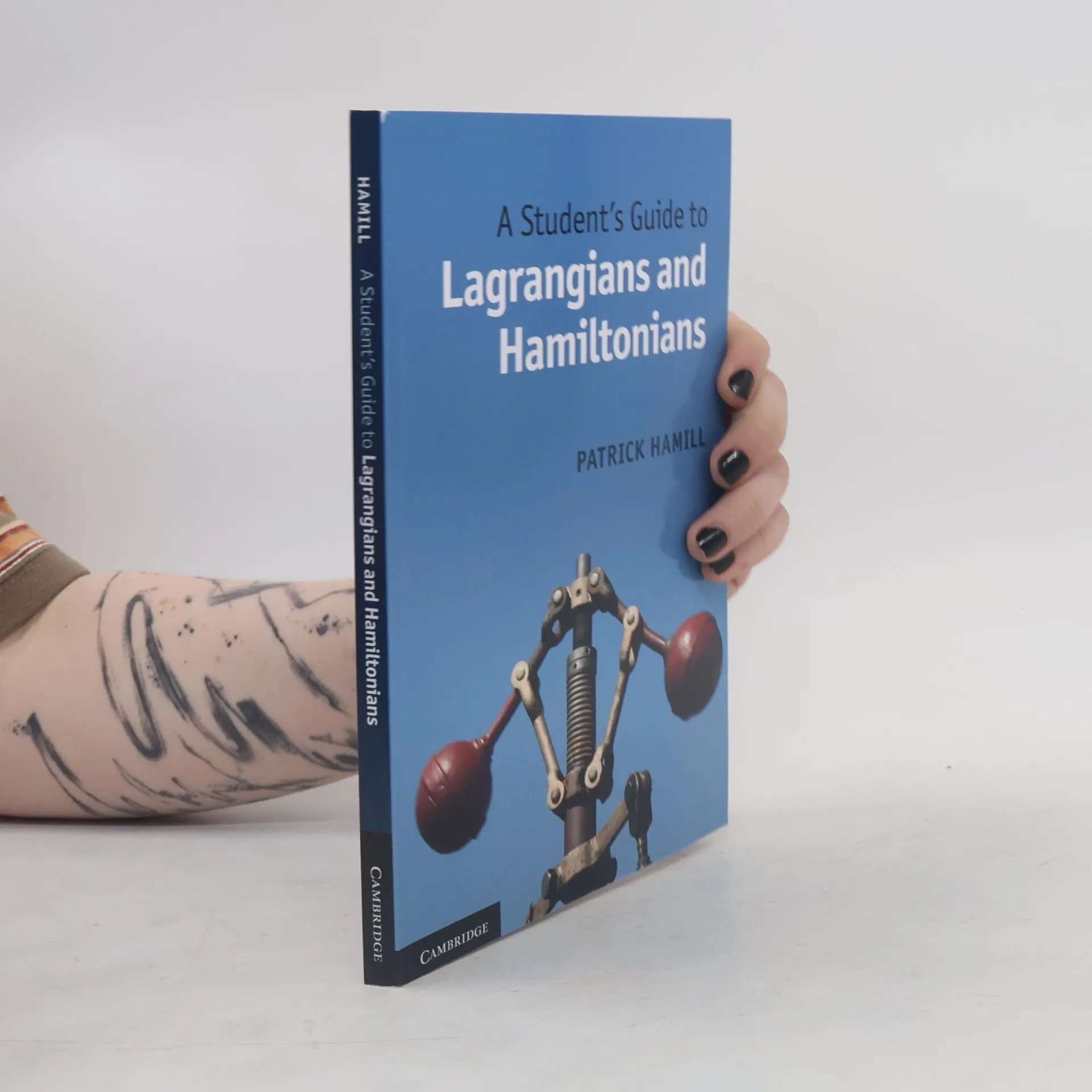
A Student's Guide to Lagrangians and Hamiltonians, Patrick Hamill
- Język

- Rok wydania
- 2013
- Oprawa
- (miękka)
Metody płatności
Brakuje nam tutaj Twojej recenzji.
- Tytuł
- A Student's Guide to Lagrangians and Hamiltonians
- Język
- angielski
- Autorzy
- Patrick Hamill
- Wydawca
- Cambridge University Press
- Rok wydania
- 2013
- Oprawa
- miękka
- Liczba stron
- 181
- ISBN10
- 1107617529
- ISBN13
- 9781107617520
- Seria
- A Student's Guide
- Ocena
- 4,05 z 5
- Opis
- A concise but rigorous treatment of variational techniques, focussing primarily on Lagrangian and Hamiltonian systems, this book is ideal for physics, engineering and mathematics students. The book begins by applying Lagrange's equations to a number of mechanical systems. It introduces the concepts of generalized coordinates and generalized momentum. Following this the book turns to the calculus of variations to derive the Euler-Lagrange equations. It introduces Hamilton's principle and uses this throughout the book to derive further results. The Hamiltonian, Hamilton's equations, canonical transformations, Poisson brackets and Hamilton-Jacobi theory are considered next. The book concludes by discussing continuous Lagrangians and Hamiltonians and how they are related to field theory. Written in clear, simple language and featuring numerous worked examples and exercises to help students master the material, this book is a valuable supplement to courses in mechanics.