

Więcej o książce
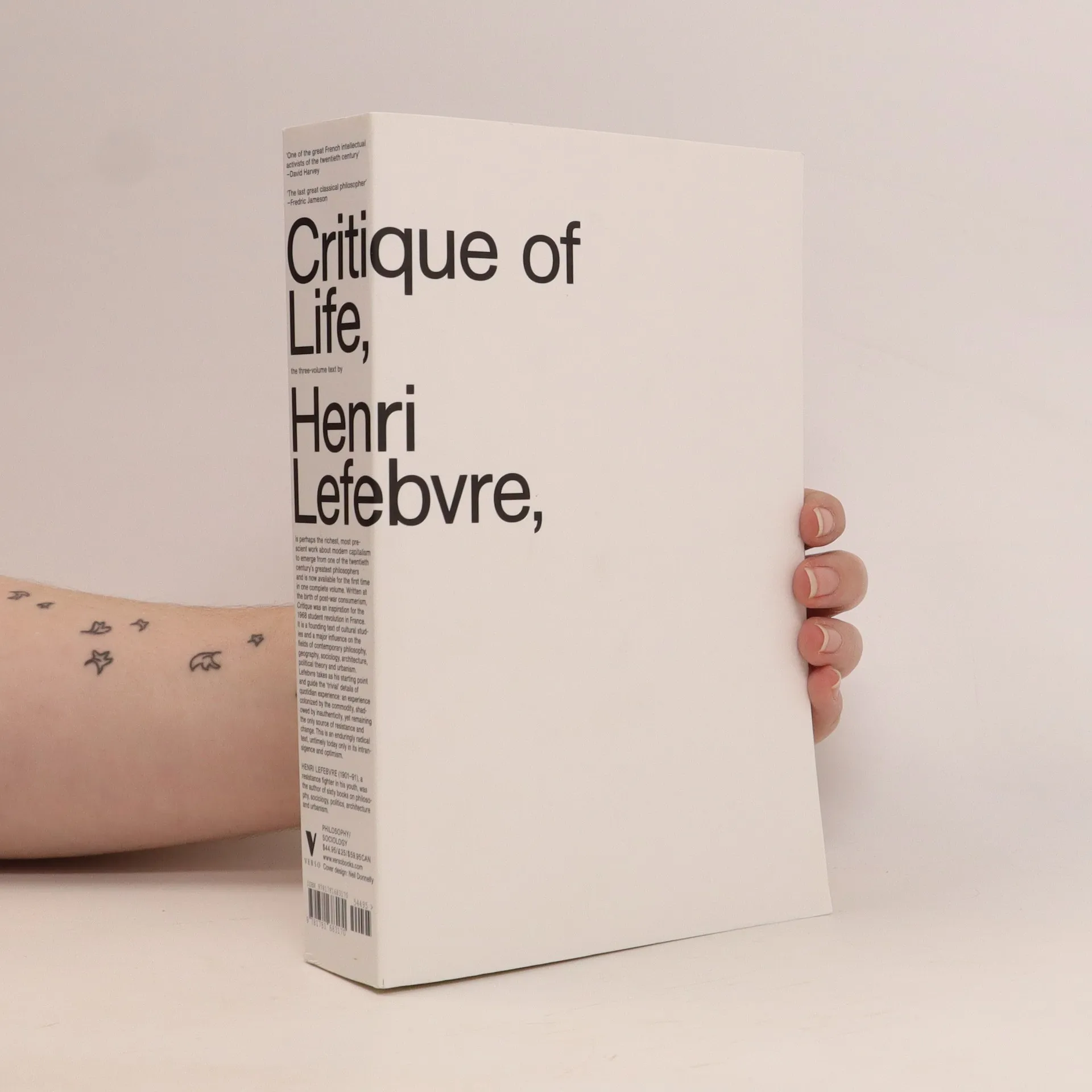
Henri Lefebvre’s magnum opus: a monumental exploration of contemporary society. Henri Lefebvre’s three-volume Critique of Everyday Life is perhaps the richest, most prescient work by one of the twentieth century’s greatest philosophers. Written at the birth of post-war consumerism, the Critique was a philosophical inspiration for the 1968 student revolution in France and is considered to be the founding text of all that we know as cultural studies, as well as a major influence on the fields of contemporary philosophy, geography, sociology, architecture, political theory and urbanism. A work of enormous range and subtlety, Lefebvre takes as his starting-point and guide the “trivial” details of quotidian experience: an experience colonized by the commodity, shadowed by inauthenticity, yet one which remains the only source of resistance and change. This is an enduringly radical text, untimely today only in its intransigence and optimism.
Zakup książki
Critique of Everyday Life, Jacques-Henri Lefebvre
- Język

- Rok wydania
- 2014
- Oprawa
- (miękka)
Metody płatności
Brakuje nam tutaj Twojej recenzji.
- Tytuł
- Critique of Everyday Life
- Język
- angielski
- Autorzy
- Jacques-Henri Lefebvre
- Wydawca
- Verso Books
- Rok wydania
- 2014
- Oprawa
- miękka
- ISBN10
- 1781683174
- ISBN13
- 9781781683170
- Seria
- Kategorie
- Ocena
- 4,15 z 5
- Opis
- Henri Lefebvre’s magnum opus: a monumental exploration of contemporary society. Henri Lefebvre’s three-volume Critique of Everyday Life is perhaps the richest, most prescient work by one of the twentieth century’s greatest philosophers. Written at the birth of post-war consumerism, the Critique was a philosophical inspiration for the 1968 student revolution in France and is considered to be the founding text of all that we know as cultural studies, as well as a major influence on the fields of contemporary philosophy, geography, sociology, architecture, political theory and urbanism. A work of enormous range and subtlety, Lefebvre takes as his starting-point and guide the “trivial” details of quotidian experience: an experience colonized by the commodity, shadowed by inauthenticity, yet one which remains the only source of resistance and change. This is an enduringly radical text, untimely today only in its intransigence and optimism.