

Parametry
Więcej o książce
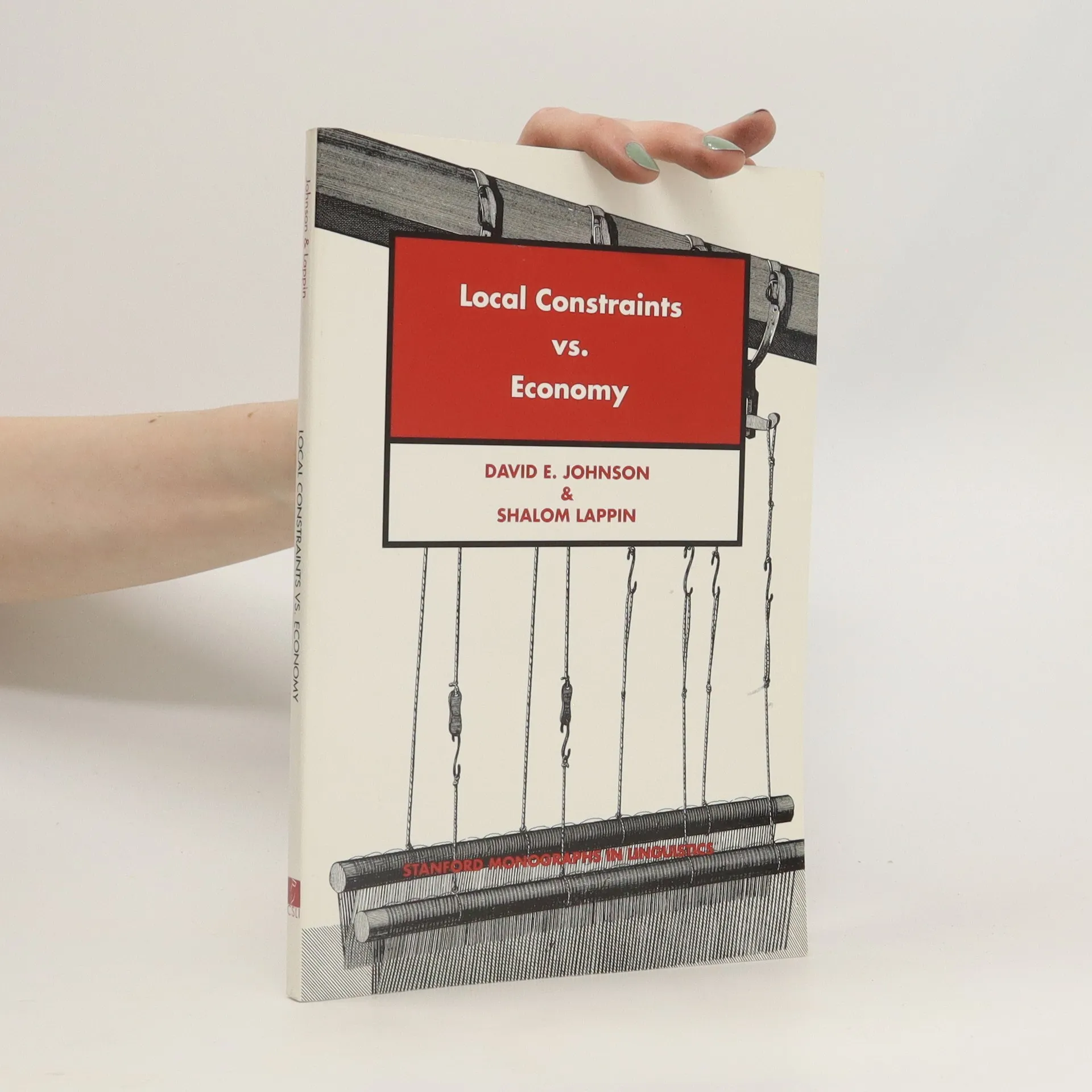
The book offers a detailed critique of the economy-of-derivation model of grammar that has emerged within the framework of Chomsky's Minimalist Program. It looks at the conceptual and computational complexity problems as well as the empirical consequences of both global and local economy principles. The book compares the economy-of-derivation model with a local constraint model of grammar that does not invoke conditions on sets of derivations or on possible operations in a derivation. It argues that the pure local constraint model of grammar avoids the complexity problems resulting from economy-of-derivation principles and provides a more satisfactory explanation of the linguistic facts that economy theorists have cited in support of their approach. The local constraint model also allows for a more natural and empirically well-motivated grammatical architecture than the one postulated by the Minimalist Program.
Zakup książki
Local Constraints Vs. Economy, Shalom Lappin, David E. Johnson
- Język

- Rok wydania
- 1999
- Oprawa
- (miękka)
Metody płatności
Nikt jeszcze nie ocenił.
- Tytuł
- Local Constraints Vs. Economy
- Język
- angielski
- Autorzy
- Shalom Lappin, David E. Johnson
- Rok wydania
- 1999
- Oprawa
- miękka
- ISBN10
- 1575861828
- ISBN13
- 9781575861821
- Seria
- Tagi
- Biznes
- Opis
- The book offers a detailed critique of the economy-of-derivation model of grammar that has emerged within the framework of Chomsky's Minimalist Program. It looks at the conceptual and computational complexity problems as well as the empirical consequences of both global and local economy principles. The book compares the economy-of-derivation model with a local constraint model of grammar that does not invoke conditions on sets of derivations or on possible operations in a derivation. It argues that the pure local constraint model of grammar avoids the complexity problems resulting from economy-of-derivation principles and provides a more satisfactory explanation of the linguistic facts that economy theorists have cited in support of their approach. The local constraint model also allows for a more natural and empirically well-motivated grammatical architecture than the one postulated by the Minimalist Program.