

Więcej o książce
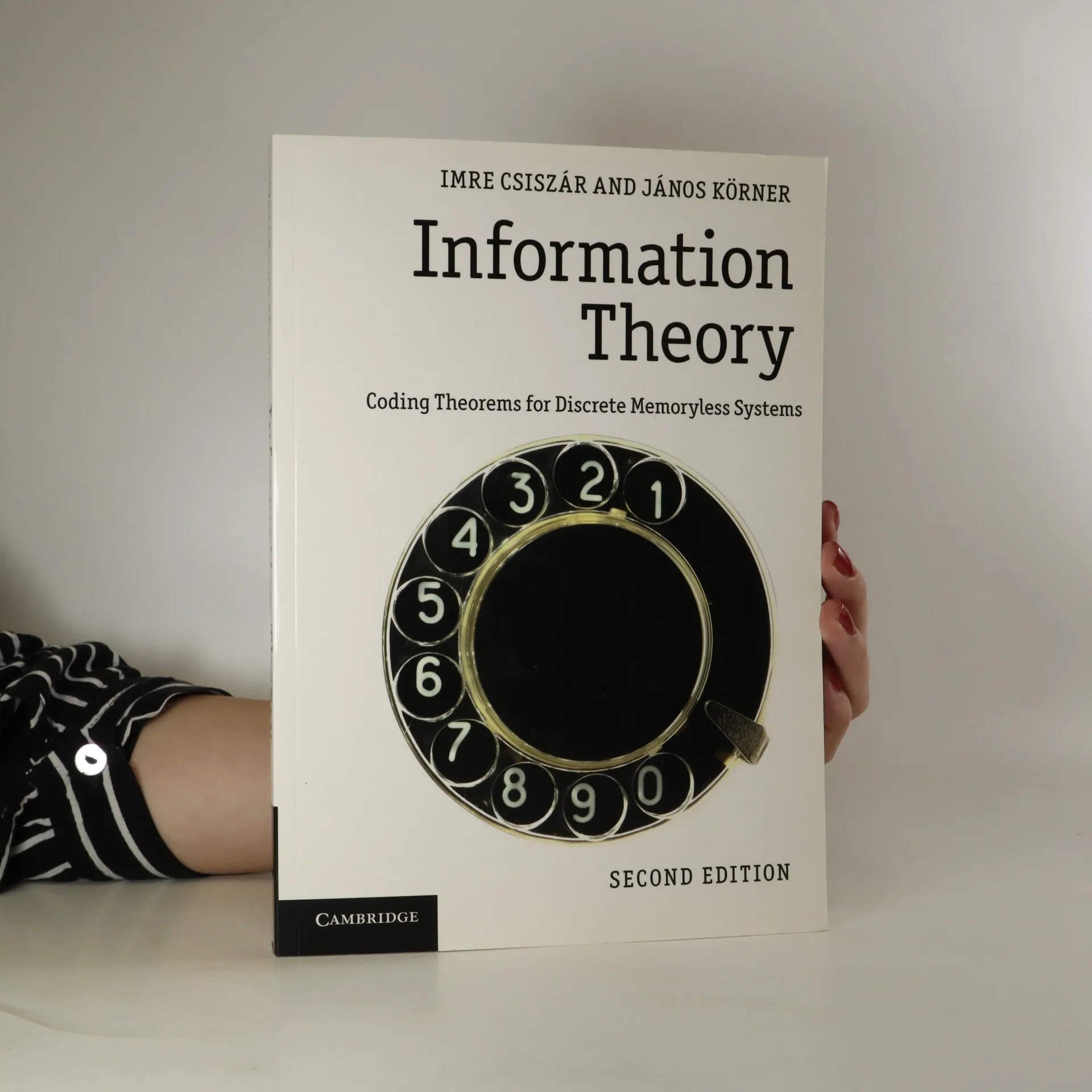
Csiszár and Körner's book is widely regarded as a classic in the field of information theory, providing deep insights and expert treatment of the key theoretical issues. It includes in-depth coverage of the mathematics of reliable information transmission, both in two-terminal and multi-terminal network scenarios. Updated and considerably expanded, this new edition presents unique discussions of information theoretic secrecy and of zero-error information theory, including the deep connections of the latter with extremal combinatorics. The presentations of all core subjects are self contained, even the advanced topics, which helps readers to understand the important connections between seemingly different problems. Finally, 320 end-of-chapter problems, together with helpful solving hints, allow readers to develop a full command of the mathematical techniques. It is an ideal resource for graduate students and researchers in electrical and electronic engineering, computer science and applied mathematics.
Zakup książki
Information theory. Coding Theorems for Discrete Memoryless Systems, Imre Csiszár
- Język

- Rok wydania
- 2015
- Oprawa
- (miękka)
Metody płatności
Nikt jeszcze nie ocenił.
- Tytuł
- Information theory. Coding Theorems for Discrete Memoryless Systems
- Język
- angielski
- Autorzy
- Imre Csiszár
- Wydawca
- Cambridge University Press
- Rok wydania
- 2015
- Oprawa
- miękka
- Liczba stron
- 520
- ISBN10
- 1107565049
- ISBN13
- 9781107565043
- Seria
- Kategorie
- Tagi
- Opis
- Csiszár and Körner's book is widely regarded as a classic in the field of information theory, providing deep insights and expert treatment of the key theoretical issues. It includes in-depth coverage of the mathematics of reliable information transmission, both in two-terminal and multi-terminal network scenarios. Updated and considerably expanded, this new edition presents unique discussions of information theoretic secrecy and of zero-error information theory, including the deep connections of the latter with extremal combinatorics. The presentations of all core subjects are self contained, even the advanced topics, which helps readers to understand the important connections between seemingly different problems. Finally, 320 end-of-chapter problems, together with helpful solving hints, allow readers to develop a full command of the mathematical techniques. It is an ideal resource for graduate students and researchers in electrical and electronic engineering, computer science and applied mathematics.