

Więcej o książce
What can humans do? What can machines do? How do humans delegate actions to machines?In this book, Harry Collins and Martin Kusch combine insights from sociology and philosophy toprovide a novel answer to these increasingly important questions.The authors begin by distinguishingbetween two basic types of intentional behavior, which they call polimorphic actions andmimeomorphic actions. Polimorphic actions (such as writing a love letter) are ones that communitymembers expect to vary with social context. Mimeomorphic actions (such a swinging a golf club) donot vary. Although machines cannot act, they can mimic mimeomorphic actions. Mimeomorphic actionsare thus the crucial link between what humans can do and what machines cando. Following a presentation of their detailed categorization of actions, theauthors apply their approach to a broad range of human-machine interactions and to learning. Keyexamples include bicycle riding and the many varieties of writing machines. They also show how theirtheory can be used to explain the operation of organizations such as restaurants and armies.Finally, they look at a historical case -- the technological development of the air pump -- applyingtheir categorization of actions to the processes of mechanization and automation. Automation, theyargue, can occur only where what we want to bring about can be brought about through mimeomorphicaction.
Zakup książki
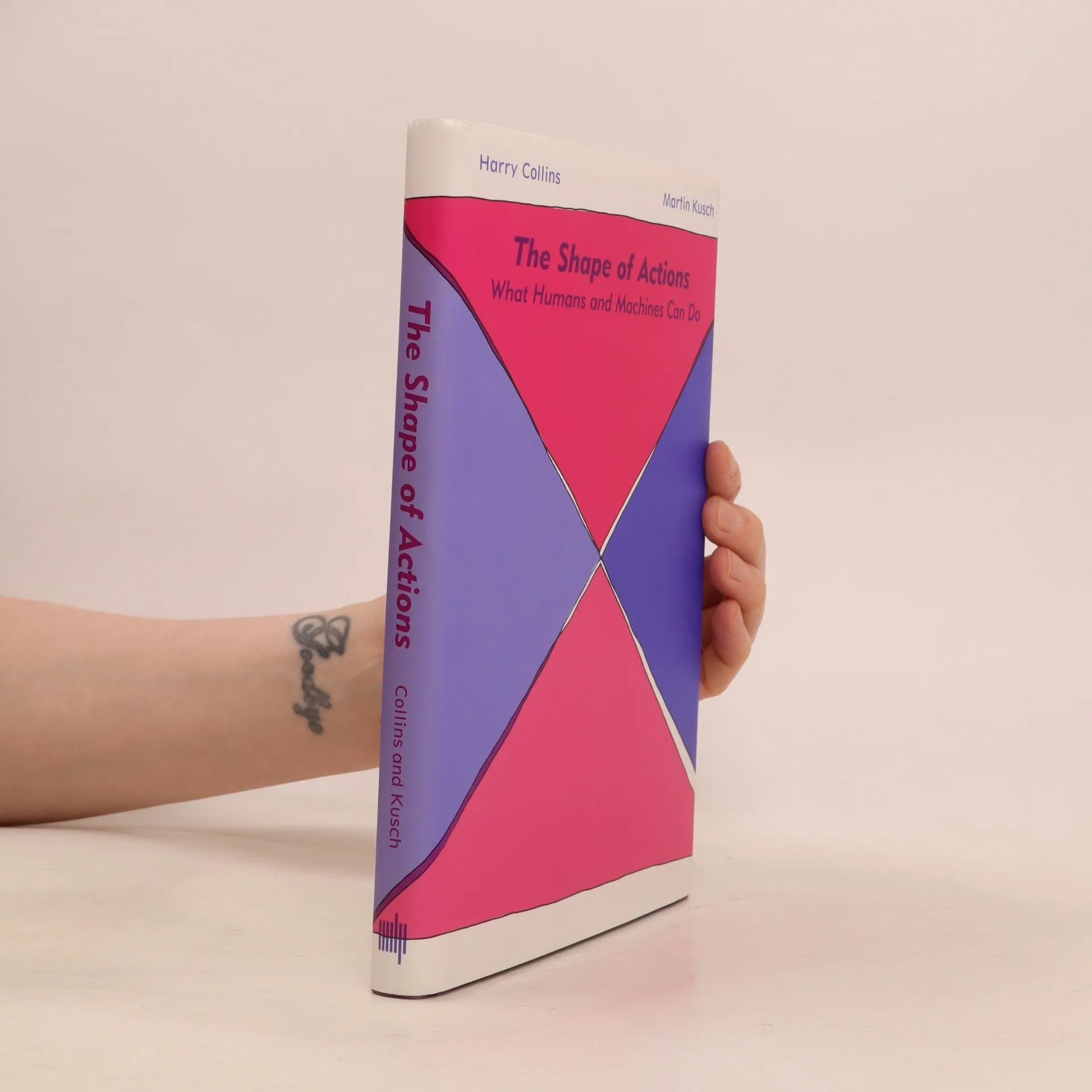
The Shape of Actions, Harry M. Collins, Martin Kusch
- Język

- Rok wydania
- 1998
- Oprawa
- (twarda)
Metody płatności
Brakuje nam tutaj Twojej recenzji.
- Tytuł
- The Shape of Actions
- Język
- angielski
- Autorzy
- Harry M. Collins, Martin Kusch
- Wydawca
- MIT Press
- Rok wydania
- 1998
- Oprawa
- twarda
- Liczba stron
- 224
- ISBN10
- 0262032570
- ISBN13
- 9780262032575
- Seria
- Tagi
- Ocena
- 4 z 5
- Opis
- What can humans do? What can machines do? How do humans delegate actions to machines?In this book, Harry Collins and Martin Kusch combine insights from sociology and philosophy toprovide a novel answer to these increasingly important questions.The authors begin by distinguishingbetween two basic types of intentional behavior, which they call polimorphic actions andmimeomorphic actions. Polimorphic actions (such as writing a love letter) are ones that communitymembers expect to vary with social context. Mimeomorphic actions (such a swinging a golf club) donot vary. Although machines cannot act, they can mimic mimeomorphic actions. Mimeomorphic actionsare thus the crucial link between what humans can do and what machines cando. Following a presentation of their detailed categorization of actions, theauthors apply their approach to a broad range of human-machine interactions and to learning. Keyexamples include bicycle riding and the many varieties of writing machines. They also show how theirtheory can be used to explain the operation of organizations such as restaurants and armies.Finally, they look at a historical case -- the technological development of the air pump -- applyingtheir categorization of actions to the processes of mechanization and automation. Automation, theyargue, can occur only where what we want to bring about can be brought about through mimeomorphicaction.