



Więcej o książce
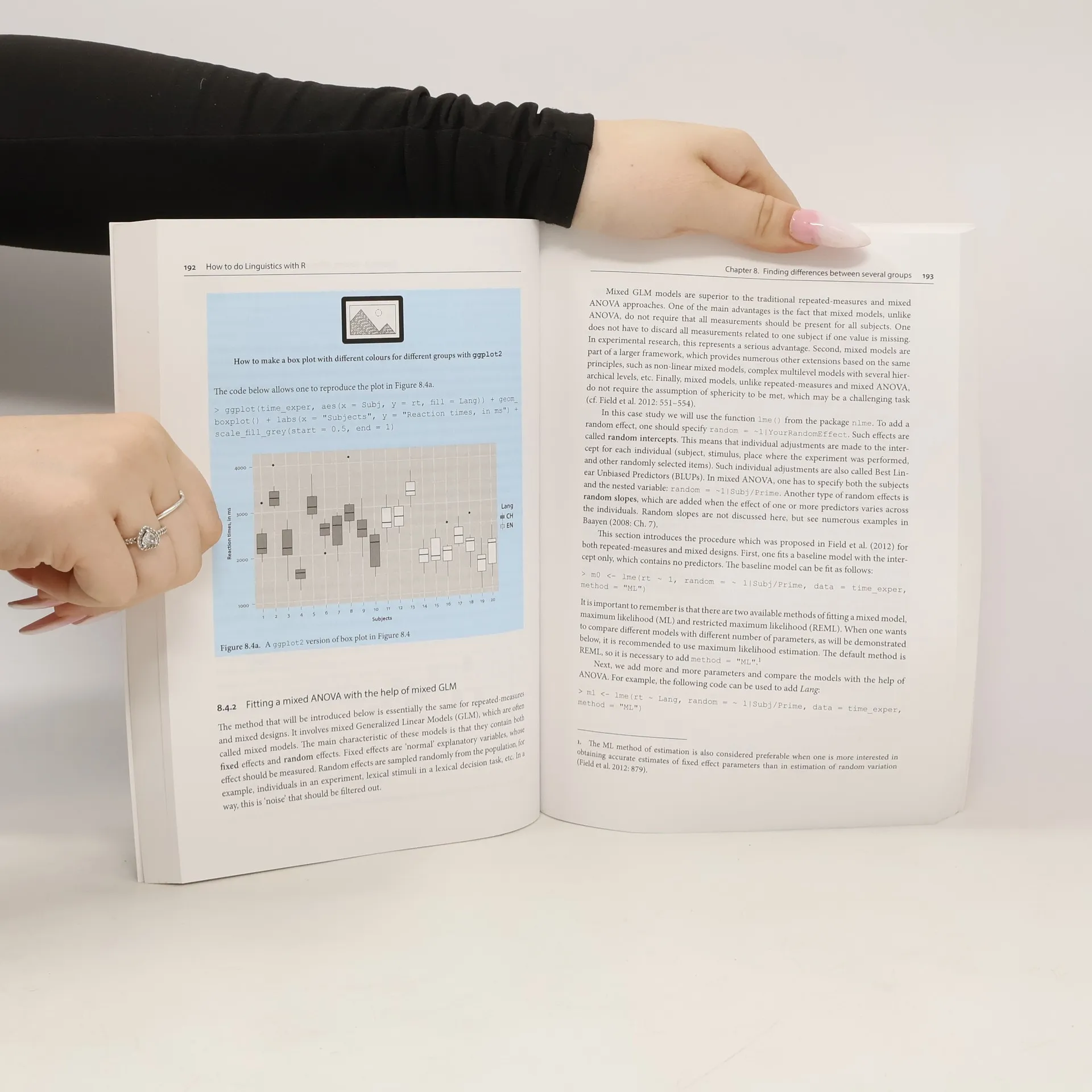
This book provides a linguist with a statistical toolkit for exploration and analysis of linguistic data. It employs R, a free software environment for statistical computing, which is increasingly popular among linguists. How to do Linguistics with R: Data exploration and statistical analysis is unique in its scope, as it covers a wide range of classical and cutting-edge statistical methods, including different flavours of regression analysis and ANOVA, random forests and conditional inference trees, as well as specific linguistic approaches, among which are Behavioural Profiles, Vector Space Models and various measures of association between words and constructions. The statistical topics are presented comprehensively, but without too much technical detail, and illustrated with linguistic case studies that answer non-trivial research questions. The book also demonstrates how to visualize linguistic data with the help of attractive informative graphs, including the popular ggplot2 system and Google visualization tools. This book has a companion website: http: //doi.org/10.1075/z.195.website
Zakup książki
How to do Linguistics with R, Natalia Levshina
- Język

- Rok wydania
- 2015
- Oprawa
- (miękka)
Metody płatności
Brakuje nam tutaj Twojej recenzji.
- Tytuł
- How to do Linguistics with R
- Język
- angielski
- Autorzy
- Natalia Levshina
- Wydawca
- John Benjamins Publishing Co
- Rok wydania
- 2015
- Oprawa
- miękka
- Liczba stron
- 454
- ISBN10
- 9027212252
- ISBN13
- 9789027212252
- Seria
- Tagi
- Lingwistyka
- Ocena
- 4,65 z 5
- Opis
- This book provides a linguist with a statistical toolkit for exploration and analysis of linguistic data. It employs R, a free software environment for statistical computing, which is increasingly popular among linguists. How to do Linguistics with R: Data exploration and statistical analysis is unique in its scope, as it covers a wide range of classical and cutting-edge statistical methods, including different flavours of regression analysis and ANOVA, random forests and conditional inference trees, as well as specific linguistic approaches, among which are Behavioural Profiles, Vector Space Models and various measures of association between words and constructions. The statistical topics are presented comprehensively, but without too much technical detail, and illustrated with linguistic case studies that answer non-trivial research questions. The book also demonstrates how to visualize linguistic data with the help of attractive informative graphs, including the popular ggplot2 system and Google visualization tools. This book has a companion website: http: //doi.org/10.1075/z.195.website