

Parametry
Więcej o książce
Error Coding for Arithmetic Processors provides an understanding of arithmetically invariant codes as a primary technique of fault-tolerant computing by discussing the progress in arithmetic coding theory. The book provides an introduction to arithmetic error code, single-error detection, and long-distance codes. It also discusses algebraic structures, linear congruences, and residues. Organized into eight chapters, this volume begins with an overview of the mathematical background in number theory, algebra, and error control techniques. It then explains the basic mathematical models on a register and its number representation system. The reader is also introduced to arithmetic processors, as well as to error control techniques. The text also explores the functional units of a digital computer, including control unit, arithmetic processor, memory unit, program unit, and input/output unit. Students in advanced undergraduate or graduate level courses, researchers, and readers who are interested in applicable knowledge on arithmetic codes will find this book extremely useful.
Zakup książki
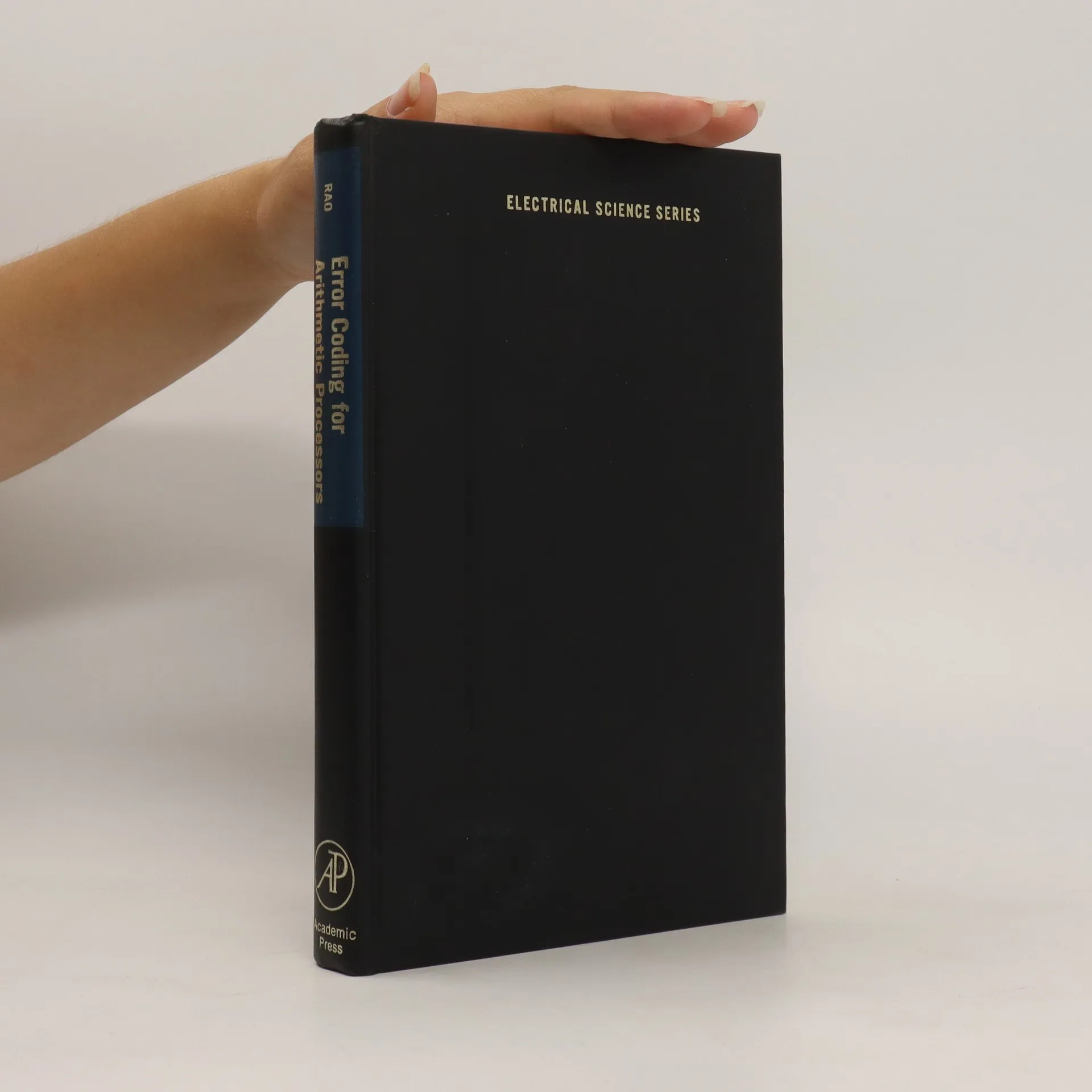
Error coding for arithmetic processors, Thammavarapu R. N. Rao
- Język

- Rok wydania
- 1974
- Oprawa
- (twarda)
Metody płatności
Nikt jeszcze nie ocenił.
- Tytuł
- Error coding for arithmetic processors
- Język
- angielski
- Autorzy
- Thammavarapu R. N. Rao
- Wydawca
- Academic press
- Rok wydania
- 1974
- Oprawa
- twarda
- ISBN10
- 0125807503
- ISBN13
- 9780125807500
- Seria
- Tagi
- Opis
- Error Coding for Arithmetic Processors provides an understanding of arithmetically invariant codes as a primary technique of fault-tolerant computing by discussing the progress in arithmetic coding theory. The book provides an introduction to arithmetic error code, single-error detection, and long-distance codes. It also discusses algebraic structures, linear congruences, and residues. Organized into eight chapters, this volume begins with an overview of the mathematical background in number theory, algebra, and error control techniques. It then explains the basic mathematical models on a register and its number representation system. The reader is also introduced to arithmetic processors, as well as to error control techniques. The text also explores the functional units of a digital computer, including control unit, arithmetic processor, memory unit, program unit, and input/output unit. Students in advanced undergraduate or graduate level courses, researchers, and readers who are interested in applicable knowledge on arithmetic codes will find this book extremely useful.