


Więcej o książce
This book is for two groups of people: those who want to study the remote planets with amateur astronomical equipment, and those who are just interested in learning about our knowledge of the remote planets. The Remote Planets, and How to Observe them is unique in that it gives a completely up-to-date summary of our current knowledge of the remote planets, and also explains how amateur astronomers can contribute to our knowledge of the remote planets. Readers are given some inspiring examples of people who, with modest commercially-made equipment, have made important contributions to our scientific knowledge. The observational section goes into great detail, including optical and CCD photometry, occultation measurements, imaging (including stacking and enhancement techniques) and polarization measurements. There are finder charts (from 2010 to 2026), complete with two sets of star-magnitudes in an appendix (one set of magnitudes are for photoelectric photometry and the other set is for visual photometry)
Zakup książki
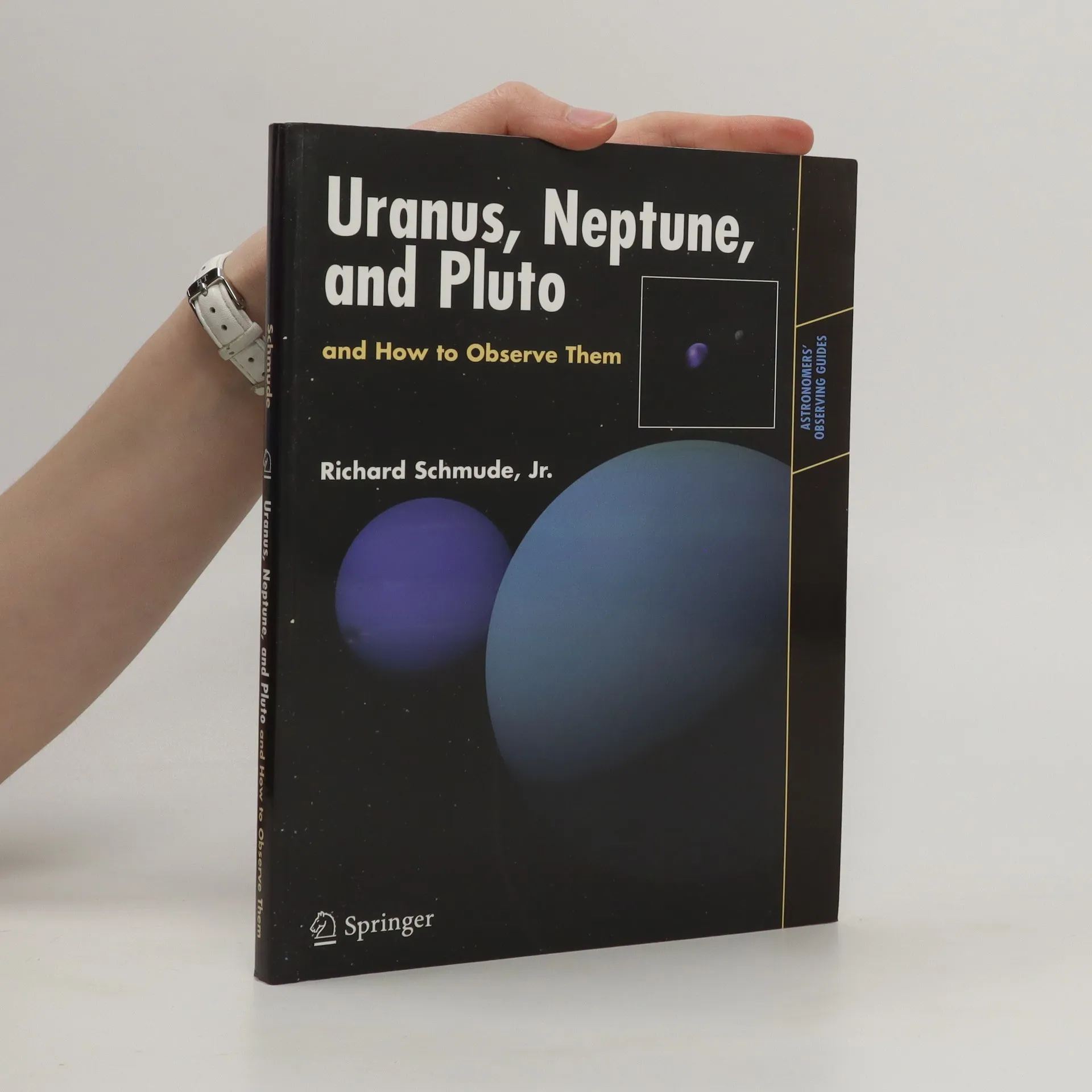
Uranus, Neptune, and Pluto and how to observe them, Richard W. Schmude
- Język

- Rok wydania
- 2008
- Oprawa
- (miękka)
Metody płatności
Brakuje nam tutaj Twojej recenzji.
- Tytuł
- Uranus, Neptune, and Pluto and how to observe them
- Język
- angielski
- Autorzy
- Richard W. Schmude
- Wydawca
- Springer
- Rok wydania
- 2008
- Oprawa
- miękka
- Liczba stron
- 230
- ISBN10
- 0387766014
- ISBN13
- 9780387766010
- Kolekcja
- Astronomers' observing guides
- Tagi
- Kosmos
- Ocena
- 3,75 z 5
- Opis
- This book is for two groups of people: those who want to study the remote planets with amateur astronomical equipment, and those who are just interested in learning about our knowledge of the remote planets. The Remote Planets, and How to Observe them is unique in that it gives a completely up-to-date summary of our current knowledge of the remote planets, and also explains how amateur astronomers can contribute to our knowledge of the remote planets. Readers are given some inspiring examples of people who, with modest commercially-made equipment, have made important contributions to our scientific knowledge. The observational section goes into great detail, including optical and CCD photometry, occultation measurements, imaging (including stacking and enhancement techniques) and polarization measurements. There are finder charts (from 2010 to 2026), complete with two sets of star-magnitudes in an appendix (one set of magnitudes are for photoelectric photometry and the other set is for visual photometry)