


Więcej o książce
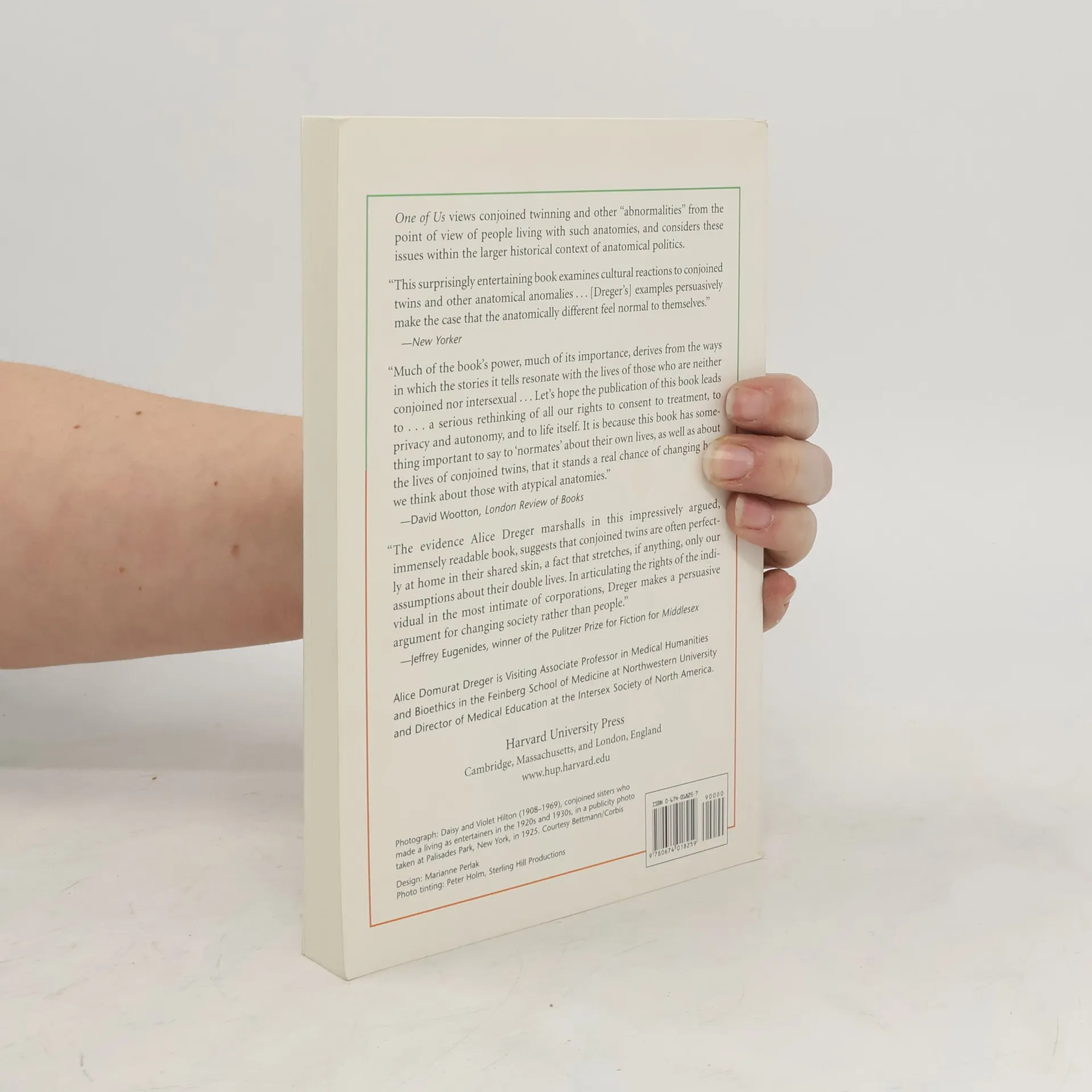
Must children born with socially challenging anatomies have their bodies changed because others cannot be expected to change their minds? One of Us views conjoined twinning and other “abnormalities” from the point of view of people living with such anatomies, and considers these issues within the larger historical context of anatomical politics.Anatomy matters, Alice Domurat Dreger tells us, because the senses we possess, the muscles we control, and the resources we require to keep our bodies alive limit and guide what we experience in any given context. Her deeply thought-provoking and compassionate work exposes the breadth and depth of that context―the extent of the social frame upon which we construct the “normal.” In doing so, the book calls into question assumptions about anatomy and normality, and transforms our understanding of how we are all intricately and inextricably joined.
Zakup książki
One of Us, Alice Domurat Dreger
- Język

- Rok wydania
- 2005
- Oprawa
- (miękka)
Metody płatności
Brakuje nam tutaj Twojej recenzji.
- Tytuł
- One of Us
- Język
- angielski
- Autorzy
- Alice Domurat Dreger
- Wydawca
- Harvard University Press
- Rok wydania
- 2005
- Oprawa
- miękka
- Liczba stron
- 208
- ISBN10
- 0674018257
- ISBN13
- 9780674018259
- Seria
- Kategorie
- Ocena
- 3,95 z 5
- Opis
- Must children born with socially challenging anatomies have their bodies changed because others cannot be expected to change their minds? One of Us views conjoined twinning and other “abnormalities” from the point of view of people living with such anatomies, and considers these issues within the larger historical context of anatomical politics.Anatomy matters, Alice Domurat Dreger tells us, because the senses we possess, the muscles we control, and the resources we require to keep our bodies alive limit and guide what we experience in any given context. Her deeply thought-provoking and compassionate work exposes the breadth and depth of that context―the extent of the social frame upon which we construct the “normal.” In doing so, the book calls into question assumptions about anatomy and normality, and transforms our understanding of how we are all intricately and inextricably joined.