

Więcej o książce
This book is about the creation and analysis of efficient data structures. It the primitive node structure; asymptotic notation for mathematically discussing performance characteristics; built-in arrays; list structures built from either nodes or arrays; iterators as an abstract model of enumerating the items in a sequence; stacks and queues for computing with last-in/first-out and first-in/first-out orderings; binary and general tree structures for searching or representing hierarchical relationships; min and max heaps for representing ordering based on priorities; graph structures for representing more general relationships between data elements; hash tables for the efficient retrieval of strings and other objects; and finally trade-offs between the structures, and strategies for picking the most appropriate ones. To understand the material in this book you should be comfortable enough in a programming language to be able to work with and write your own variables, arithmetic expressions, if-else conditions, loops, subroutines (also known as functions), pointers (also known as references or object handles), structures (also known as records or classes), simple input and output, and simple recursion. Because many different languages approach the construction of data structures differently, we use pseudo-code so that you can translate the code into your own language.
Zakup książki
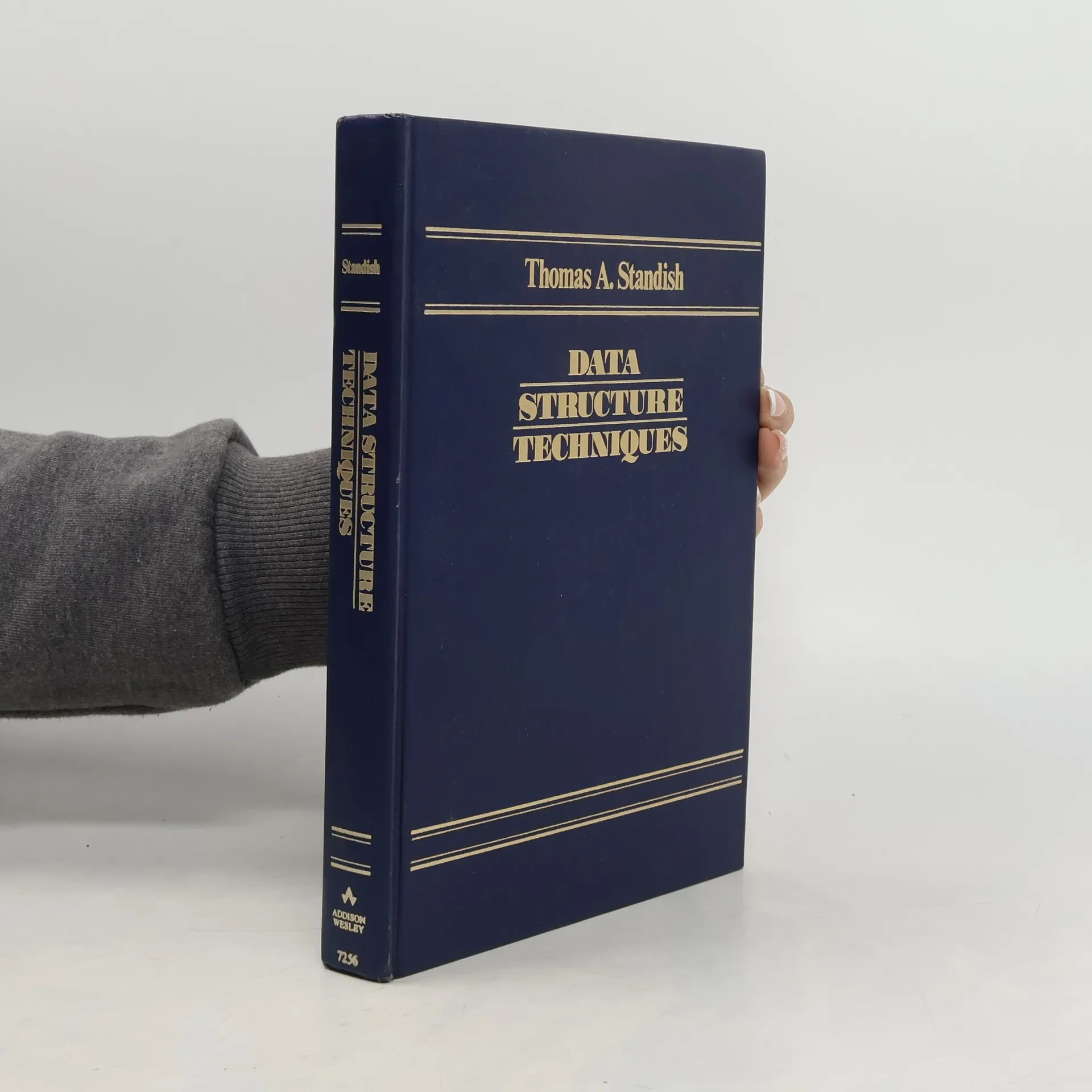
Data Structure Techniques, Thomas A. Standish
- Język

- Rok wydania
- 1980
- Oprawa
- (twarda)
Metody płatności
Brakuje nam tutaj Twojej recenzji.
- Tytuł
- Data Structure Techniques
- Język
- angielski
- Autorzy
- Thomas A. Standish
- Wydawca
- Addison-Wesley
- Rok wydania
- 1980
- Oprawa
- twarda
- Liczba stron
- 447
- ISBN10
- 0201072564
- ISBN13
- 9780201072563
- Seria
- Tagi
- Ocena
- 4 z 5
- Opis
- This book is about the creation and analysis of efficient data structures. It the primitive node structure; asymptotic notation for mathematically discussing performance characteristics; built-in arrays; list structures built from either nodes or arrays; iterators as an abstract model of enumerating the items in a sequence; stacks and queues for computing with last-in/first-out and first-in/first-out orderings; binary and general tree structures for searching or representing hierarchical relationships; min and max heaps for representing ordering based on priorities; graph structures for representing more general relationships between data elements; hash tables for the efficient retrieval of strings and other objects; and finally trade-offs between the structures, and strategies for picking the most appropriate ones. To understand the material in this book you should be comfortable enough in a programming language to be able to work with and write your own variables, arithmetic expressions, if-else conditions, loops, subroutines (also known as functions), pointers (also known as references or object handles), structures (also known as records or classes), simple input and output, and simple recursion. Because many different languages approach the construction of data structures differently, we use pseudo-code so that you can translate the code into your own language.