

Więcej o książce
In the year 1890 Tesla severed his connection with the Westinghouse Company, since which time he has devoted himself entirely to the study of alternating currents of high frequencies and very high potentials. No comment is necessary on his interesting achievements in this field; the famous London lecture published in this volume is a proof in itself. His first lecture on his researches in this new branch of electricity, which he may be said to have created, was delivered before the American Institute of Electrical Engineers on May 20, 1891, and remains one of the most interesting papers read before that society. The present lecture may be read and understood by anyone even though he has not read the earlier one. It forms a sort of continuation of the latter, and includes chiefly the results of his researches since that time.
Zakup książki
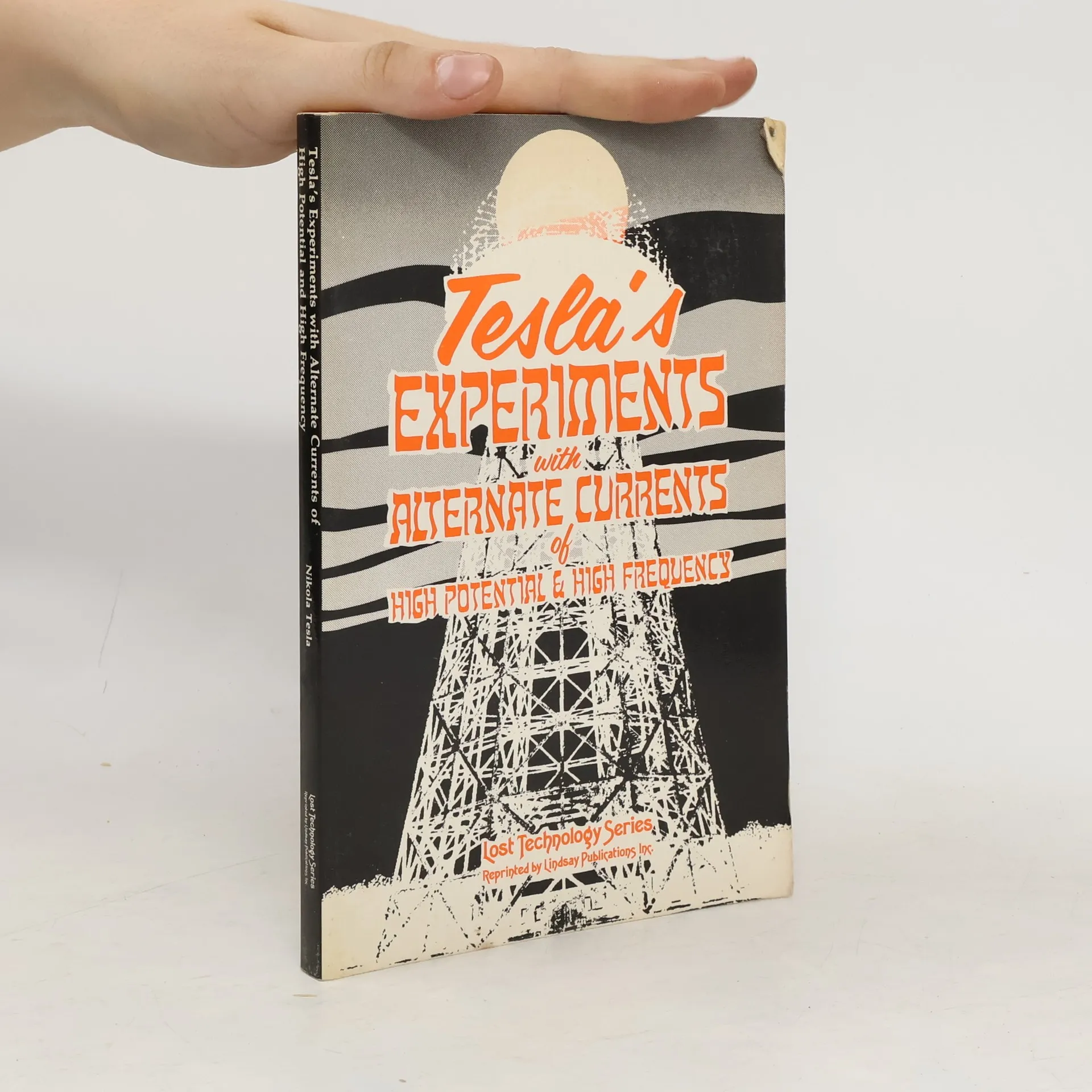
Tesla's Experiments with Alternate Currents of High Potential & High Frequency, Nikola Tesla
- Język

- Rok wydania
- 1986
- Oprawa
- (miękka)
Metody płatności
Brakuje nam tutaj Twojej recenzji.
- Tytuł
- Tesla's Experiments with Alternate Currents of High Potential & High Frequency
- Język
- angielski
- Autorzy
- Nikola Tesla
- Wydawca
- Lindsay Publications
- Rok wydania
- 1986
- Oprawa
- miękka
- Liczba stron
- 162
- ISBN10
- 0917914392
- ISBN13
- 9780917914393
- Seria
- Tagi
- Ocena
- 3 z 5
- Opis
- In the year 1890 Tesla severed his connection with the Westinghouse Company, since which time he has devoted himself entirely to the study of alternating currents of high frequencies and very high potentials. No comment is necessary on his interesting achievements in this field; the famous London lecture published in this volume is a proof in itself. His first lecture on his researches in this new branch of electricity, which he may be said to have created, was delivered before the American Institute of Electrical Engineers on May 20, 1891, and remains one of the most interesting papers read before that society. The present lecture may be read and understood by anyone even though he has not read the earlier one. It forms a sort of continuation of the latter, and includes chiefly the results of his researches since that time.