

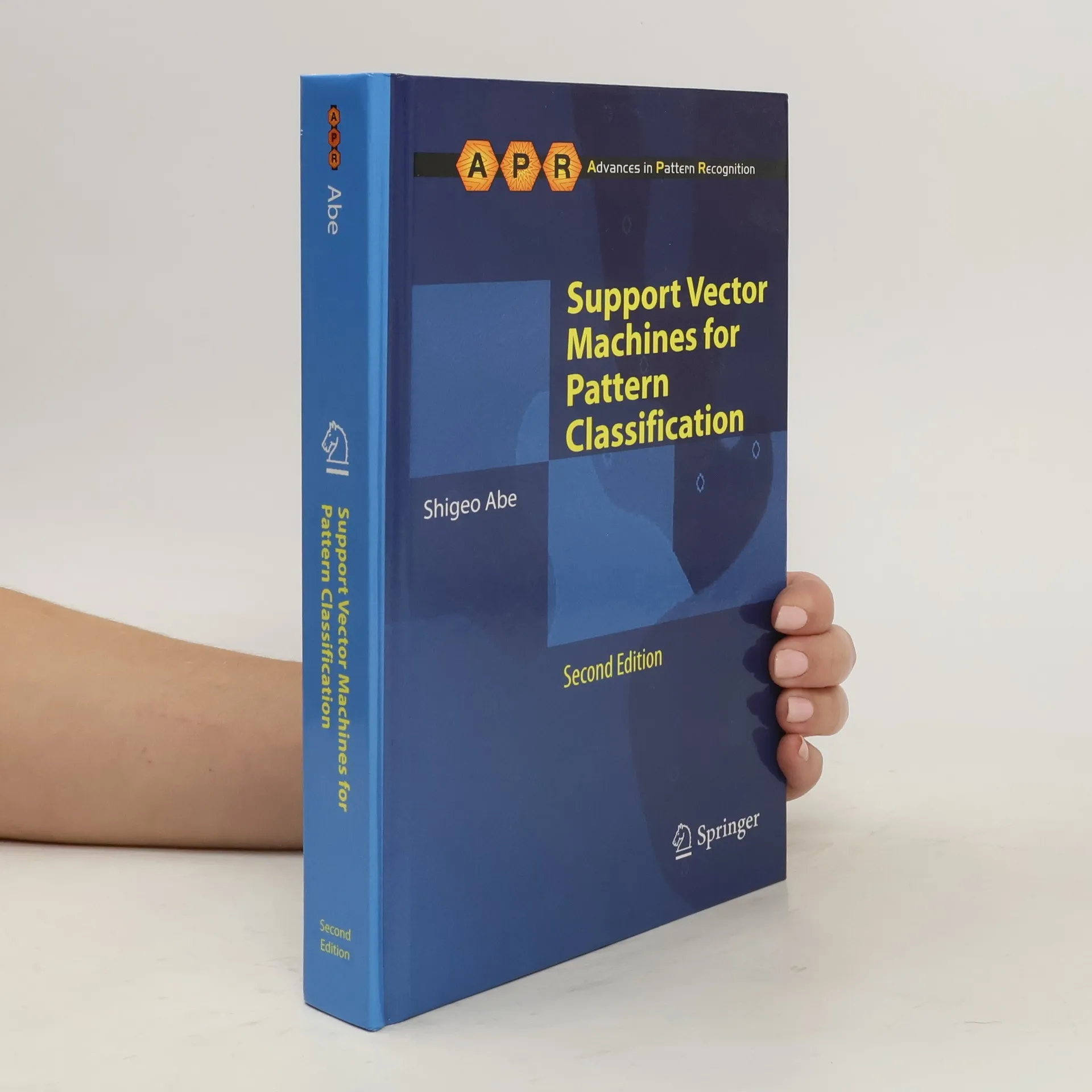


Więcej o książce
A guide on the use of SVMs in pattern classification, including a rigorous performance comparison of classifiers and regressors. The book presents architectures for multiclass classification and function approximation problems, as well as evaluation criteria for classifiers and regressors. Features: Clarifies the characteristics of two-class SVMs; Discusses kernel methods for improving the generalization ability of neural networks and fuzzy systems; Contains ample illustrations and examples; Includes performance evaluation using publicly available data sets; Examines Mahalanobis kernels, empirical feature space, and the effect of model selection by cross-validation; Covers sparse SVMs, learning using privileged information, semi-supervised learning, multiple classifier systems, and multiple kernel learning; Explores incremental training based batch training and active-set training methods, and decomposition techniques for linear programming SVMs; Discusses variable selection for support vector regressors.
Zakup książki
Support Vector Machines for Pattern Classification, Shigeo Abe
- Język

- Rok wydania
- 2010
- Oprawa
- (twarda)
Metody płatności
Brakuje nam tutaj Twojej recenzji.
- Tytuł
- Support Vector Machines for Pattern Classification
- Język
- angielski
- Autorzy
- Shigeo Abe
- Wydawca
- Springer London
- Rok wydania
- 2010
- Oprawa
- twarda
- Liczba stron
- 471
- ISBN10
- 1849960976
- ISBN13
- 9781849960977
- Seria
- Tagi
- Ocena
- 4,2 z 5
- Opis
- A guide on the use of SVMs in pattern classification, including a rigorous performance comparison of classifiers and regressors. The book presents architectures for multiclass classification and function approximation problems, as well as evaluation criteria for classifiers and regressors. Features: Clarifies the characteristics of two-class SVMs; Discusses kernel methods for improving the generalization ability of neural networks and fuzzy systems; Contains ample illustrations and examples; Includes performance evaluation using publicly available data sets; Examines Mahalanobis kernels, empirical feature space, and the effect of model selection by cross-validation; Covers sparse SVMs, learning using privileged information, semi-supervised learning, multiple classifier systems, and multiple kernel learning; Explores incremental training based batch training and active-set training methods, and decomposition techniques for linear programming SVMs; Discusses variable selection for support vector regressors.