



Więcej o książce
This clear and balanced introduction to welfare economics reflects the most recent advances in the field. Designed for third-year undergraduate and graduate courses, it offers an extensive treatment of both the theory of welfare economics and the techniques for applying that theory to real problems.The first part of the book presents a synthesis of the theory. Starting from the premise that the purpose of theory is to provide criteria for ordering alternative economic states, the authors analyse the relationship between individual and social orderings. They discuss the conditions of Pareto efficiency and optimality as well as the ways in which market economies may fail to achieve a Pareto optimal allocation of resources. They go on to evaluate the theory of social welfare functions, paying particular attention to recent developments.The second part of the book considers the principles of applied welfare economics. Developing the use of the compensating variation as their main tool, the authors discuss welfare change measurement in single-person and many-person economies. In the final chapter they survey the recent literature on cost-benefit analysis.
Zakup książki
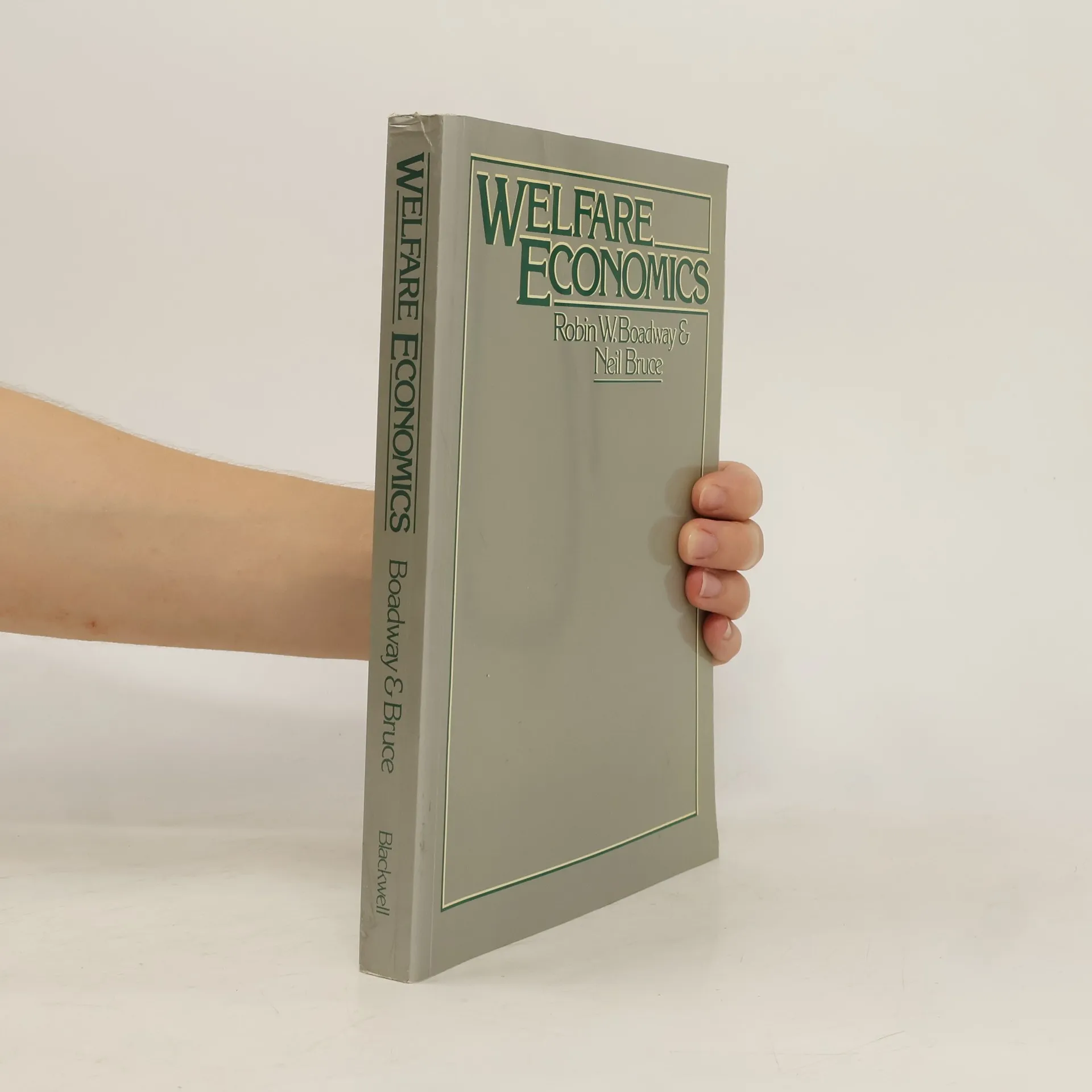
Welfare Economics, Robin W. Boadway, Neil Bruce
- Język

- Rok wydania
- 1991
- Oprawa
- (miękka)
Metody płatności
Nikt jeszcze nie ocenił.
- Tytuł
- Welfare Economics
- Język
- angielski
- Autorzy
- Robin W. Boadway, Neil Bruce
- Wydawca
- Wiley-Blackwell
- Rok wydania
- 1991
- Oprawa
- miękka
- Liczba stron
- 368
- ISBN10
- 0631133275
- ISBN13
- 9780631133278
- Seria
- Kategorie
- Tagi
- Biznes, Teoria prawa
- Opis
- This clear and balanced introduction to welfare economics reflects the most recent advances in the field. Designed for third-year undergraduate and graduate courses, it offers an extensive treatment of both the theory of welfare economics and the techniques for applying that theory to real problems.The first part of the book presents a synthesis of the theory. Starting from the premise that the purpose of theory is to provide criteria for ordering alternative economic states, the authors analyse the relationship between individual and social orderings. They discuss the conditions of Pareto efficiency and optimality as well as the ways in which market economies may fail to achieve a Pareto optimal allocation of resources. They go on to evaluate the theory of social welfare functions, paying particular attention to recent developments.The second part of the book considers the principles of applied welfare economics. Developing the use of the compensating variation as their main tool, the authors discuss welfare change measurement in single-person and many-person economies. In the final chapter they survey the recent literature on cost-benefit analysis.