


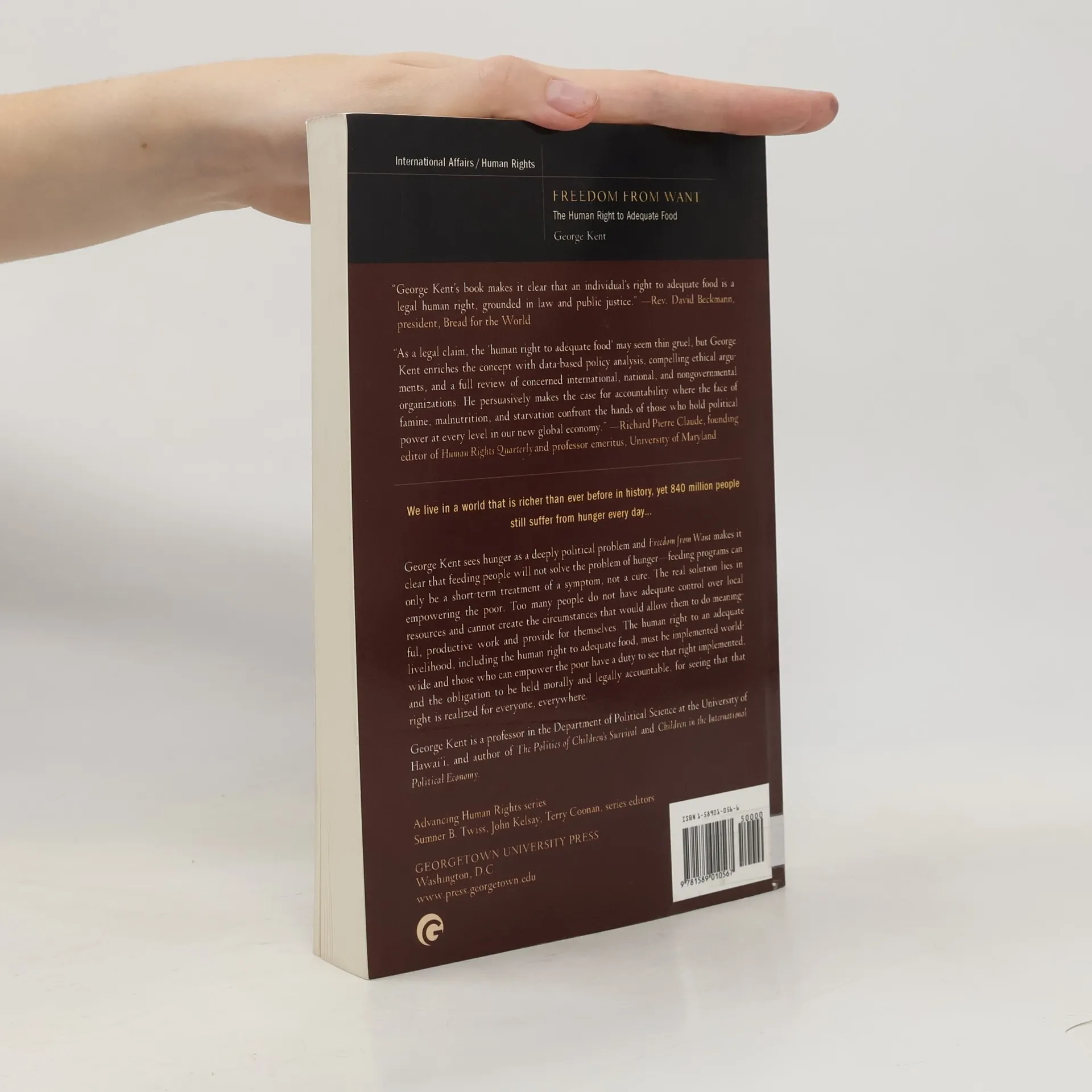

Więcej o książce
There is, literally, a world of difference between the statements "Everyone should have adequate food," and "Everyone has the right to adequate food." In George Kent's view, the lofty rhetoric of the first statement will not be fulfilled until we take the second statement seriously. Kent sees hunger as a deeply political problem. Too many people do not have adequate control over local resources and cannot create the circumstances that would allow them to do meaningful, productive work and provide for themselves. The human right to an adequate livelihood, including the human right to adequate food, needs to be implemented worldwide in a systematic way.Freedom from Want makes it clear that feeding people will not solve the problem of hunger, for feeding programs can only be a short-term treatment of a symptom, not a cure. The real solution lies in empowering the poor. Governments, in particular, must ensure that their people face enabling conditions that allow citizens to provide for themselves.In a wider sense, Kent brings an understanding of human rights as a universal system, applicable to all nations on a global scale. If, as Kent argues, everyone has a human right to adequate food, it follows that those who can empower the poor have a duty to see that right implemented, and the obligation to be held morally and legally accountable, for seeing that that right is realized for everyone, everywhere.
Zakup książki
Freedom from Want, George Kent, Jean Ziegler
- Język

- Rok wydania
- 2005
- Oprawa
- (miękka)
Metody płatności
Brakuje nam tutaj Twojej recenzji.
- Tytuł
- Freedom from Want
- Podtytuł
- The Human Right to Adequate Food
- Język
- angielski
- Autorzy
- George Kent, Jean Ziegler
- Wydawca
- Georgetown University Press
- Rok wydania
- 2005
- Oprawa
- miękka
- Liczba stron
- 290
- ISBN10
- 1589010566
- ISBN13
- 9781589010567
- Seria
- Tagi
- Biznes, Polityka, Jedzenie, Bieda, Prawa człowieka
- Ocena
- 4 z 5
- Opis
- There is, literally, a world of difference between the statements "Everyone should have adequate food," and "Everyone has the right to adequate food." In George Kent's view, the lofty rhetoric of the first statement will not be fulfilled until we take the second statement seriously. Kent sees hunger as a deeply political problem. Too many people do not have adequate control over local resources and cannot create the circumstances that would allow them to do meaningful, productive work and provide for themselves. The human right to an adequate livelihood, including the human right to adequate food, needs to be implemented worldwide in a systematic way.Freedom from Want makes it clear that feeding people will not solve the problem of hunger, for feeding programs can only be a short-term treatment of a symptom, not a cure. The real solution lies in empowering the poor. Governments, in particular, must ensure that their people face enabling conditions that allow citizens to provide for themselves.In a wider sense, Kent brings an understanding of human rights as a universal system, applicable to all nations on a global scale. If, as Kent argues, everyone has a human right to adequate food, it follows that those who can empower the poor have a duty to see that right implemented, and the obligation to be held morally and legally accountable, for seeing that that right is realized for everyone, everywhere.