

Parametry
Więcej o książce
Several decades have elapsed since the publication of any similar book, and this lack has been felt keenly by all friends of astronomy. In our space age, astronomical knowledge arouses public interest more and more. Practical observation at the telescope depends more than anything else on such knowledge. The educational value of such training is undisputed. The work of the amateur astronomer can also contribute essentially to the work of the professionals. It is from these points of view that this handbook aims to help with versatile advice. The book shows the wide range of applied astronomy, as it presents itself to the friend of the stars; in mathematical-physical fields, precision mechanics, optics, and social relations. Beyond the circle of amateur astronomers, the book is addressed to lecturers, teachers, students, and pupils. It wishes to serve them as a guide to "astronomical experiments," which should be performed in primary and secondary schools, specialist colleges, and extramural courses.
Zakup książki
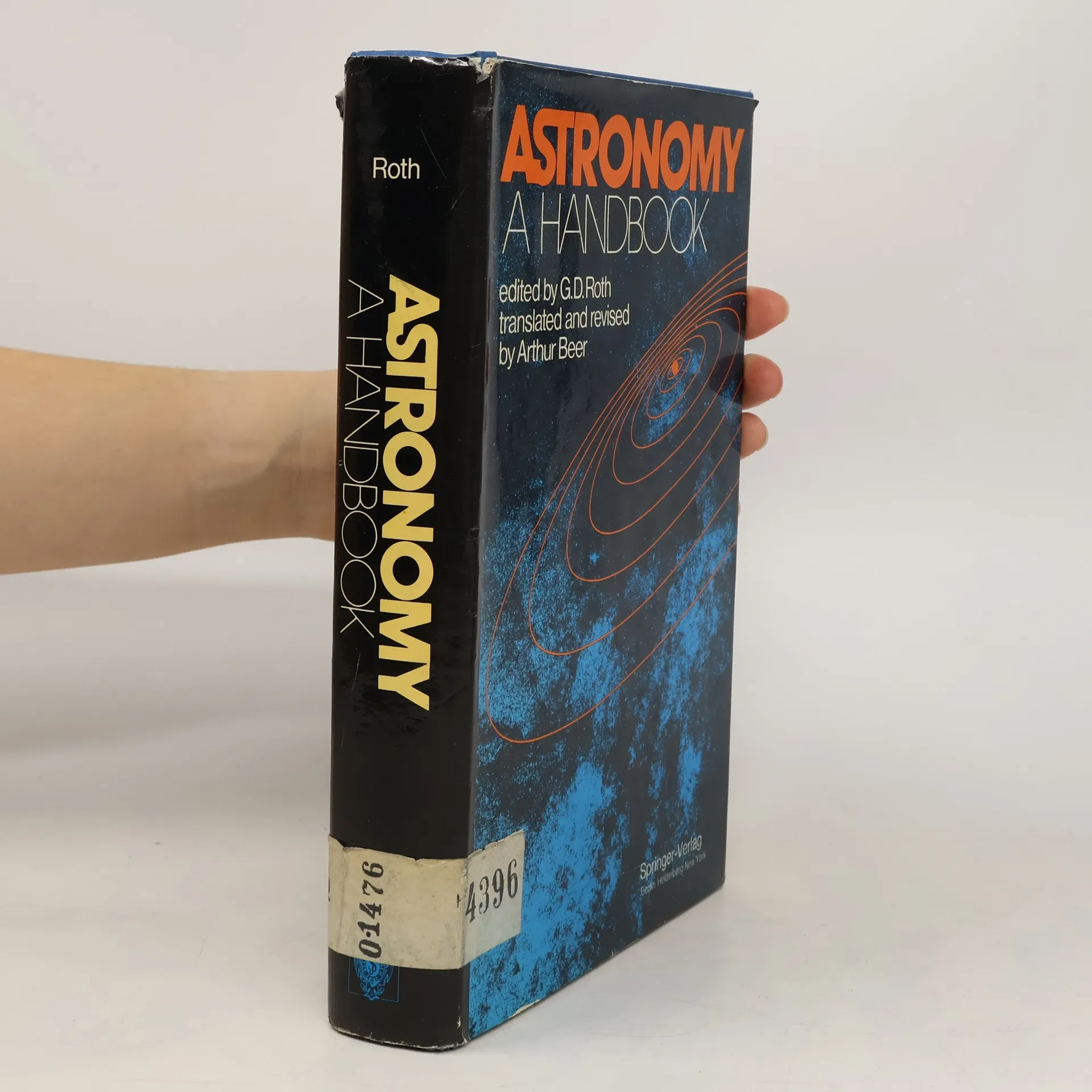
Astronomy. A Handbook, Günter Dietmar Roth
- Język

- Rok wydania
- 1975
- Oprawa
- (twarda)
Metody płatności
Nikt jeszcze nie ocenił.
- Tytuł
- Astronomy. A Handbook
- Język
- angielski
- Autorzy
- Günter Dietmar Roth
- Wydawca
- Springer
- Rok wydania
- 1975
- Oprawa
- twarda
- Seria
- Tagi
- Kosmos
- Opis
- Several decades have elapsed since the publication of any similar book, and this lack has been felt keenly by all friends of astronomy. In our space age, astronomical knowledge arouses public interest more and more. Practical observation at the telescope depends more than anything else on such knowledge. The educational value of such training is undisputed. The work of the amateur astronomer can also contribute essentially to the work of the professionals. It is from these points of view that this handbook aims to help with versatile advice. The book shows the wide range of applied astronomy, as it presents itself to the friend of the stars; in mathematical-physical fields, precision mechanics, optics, and social relations. Beyond the circle of amateur astronomers, the book is addressed to lecturers, teachers, students, and pupils. It wishes to serve them as a guide to "astronomical experiments," which should be performed in primary and secondary schools, specialist colleges, and extramural courses.