




Parametry
- 816 stron
- 29 godzin czytania
Więcej o książce
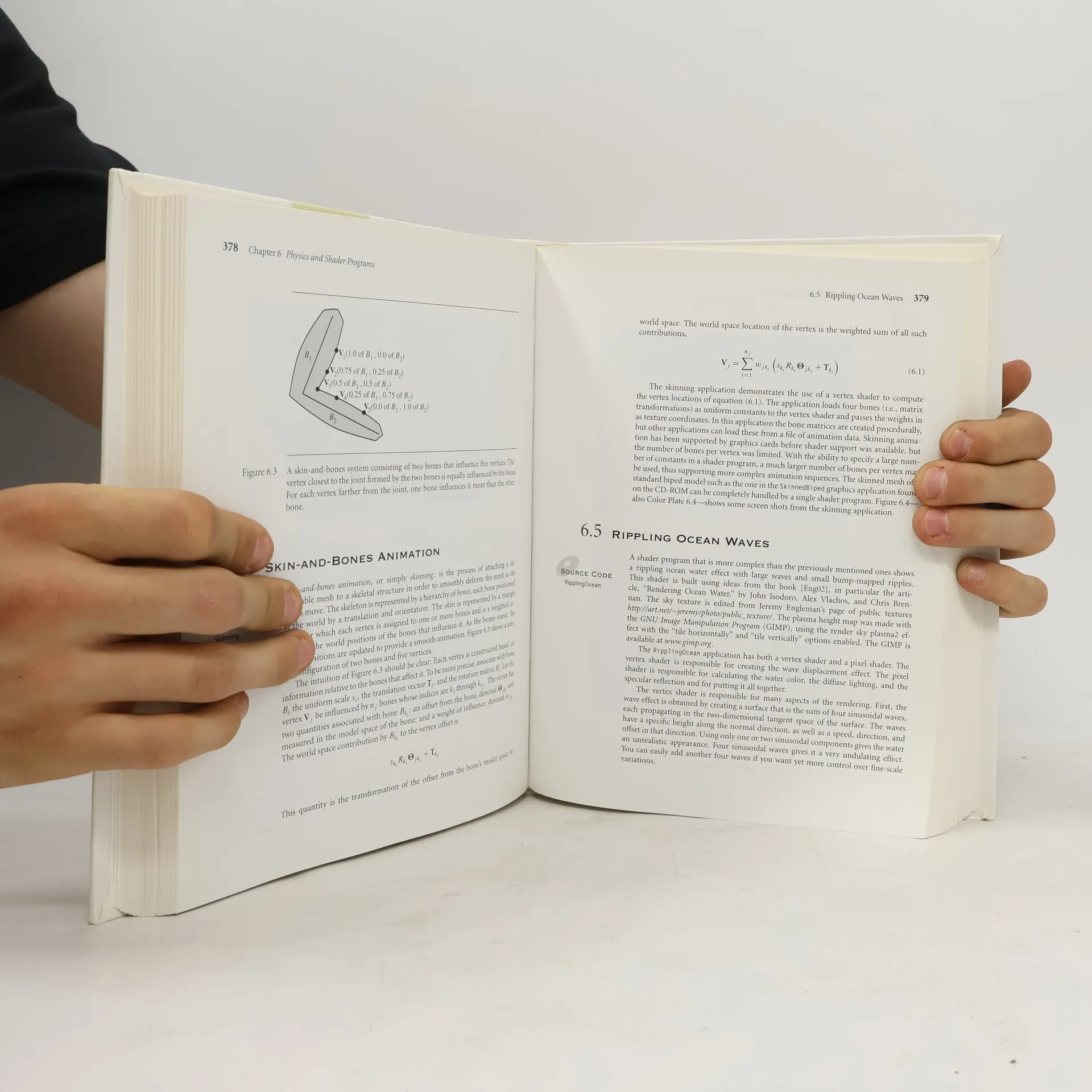
Game Physics is an introduction to the ideas and techniques needed to create physically realistic 3D graphic environments. As a companion volume to Dave Eberly's industry standard 3D Game Engine Design , Game Physics shares a similar practical approach and format. Dave includes simulations to introduce the key problems involved and then gradually reveals the mathematical and physical concepts needed to solve them. He then describes all the algorithmic foundations and uses code examples and working source code to show how they are implemented, culminating in a large collection of physical simulations. This book tackles the complex, challenging issues that other books avoid, including Lagrangian dynamics, rigid body dynamics, impulse methods, resting contact, linear complementarity problems, deformable bodies, mass-spring systems, friction, numerical solution of differential equations, numerical stability and its relationship to physical stability, and Verlet integration methods. Dave even describes when real physics isn't necessary-and hacked physics will do.
Zakup książki
Game Physics, David H. Eberly
- Język

- Rok wydania
- 2003
- Oprawa
- (twarda)
Metody płatności
Brakuje nam tutaj Twojej recenzji.
- Tytuł
- Game Physics
- Język
- angielski
- Autorzy
- David H. Eberly
- Wydawca
- CRC Press
- Rok wydania
- 2003
- Oprawa
- twarda
- Liczba stron
- 816
- ISBN10
- 1558607404
- ISBN13
- 9781558607408
- Seria
- Kategorie
- Tagi
- Nauki przyrodnicze, Poradniki, Sztuka, USA, Technologia, Gry, Oprogramowanie, Grafika, Grafika komputerowa
- Ocena
- 3,55 z 5
- Opis
- Game Physics is an introduction to the ideas and techniques needed to create physically realistic 3D graphic environments. As a companion volume to Dave Eberly's industry standard 3D Game Engine Design , Game Physics shares a similar practical approach and format. Dave includes simulations to introduce the key problems involved and then gradually reveals the mathematical and physical concepts needed to solve them. He then describes all the algorithmic foundations and uses code examples and working source code to show how they are implemented, culminating in a large collection of physical simulations. This book tackles the complex, challenging issues that other books avoid, including Lagrangian dynamics, rigid body dynamics, impulse methods, resting contact, linear complementarity problems, deformable bodies, mass-spring systems, friction, numerical solution of differential equations, numerical stability and its relationship to physical stability, and Verlet integration methods. Dave even describes when real physics isn't necessary-and hacked physics will do.