

Więcej o książce
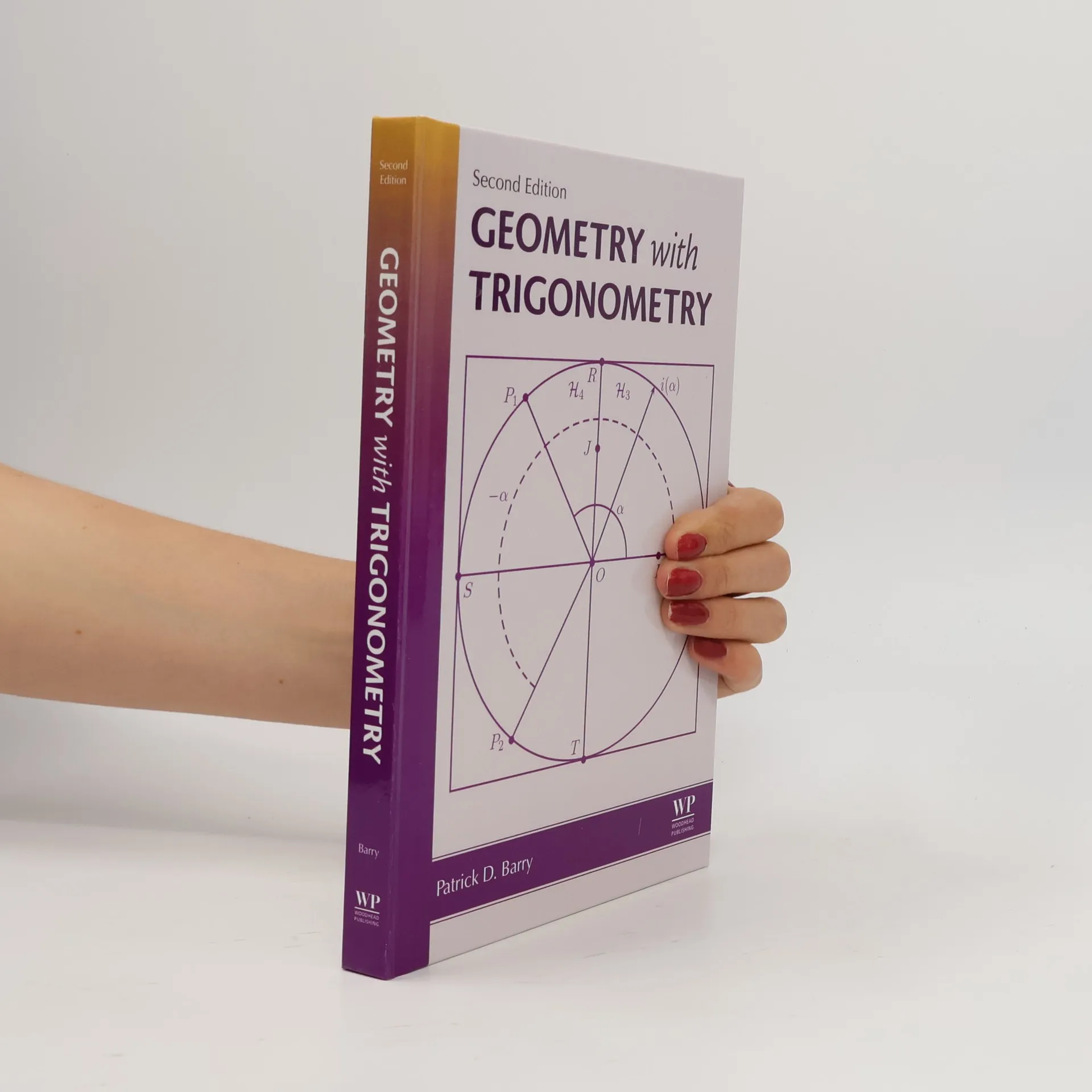
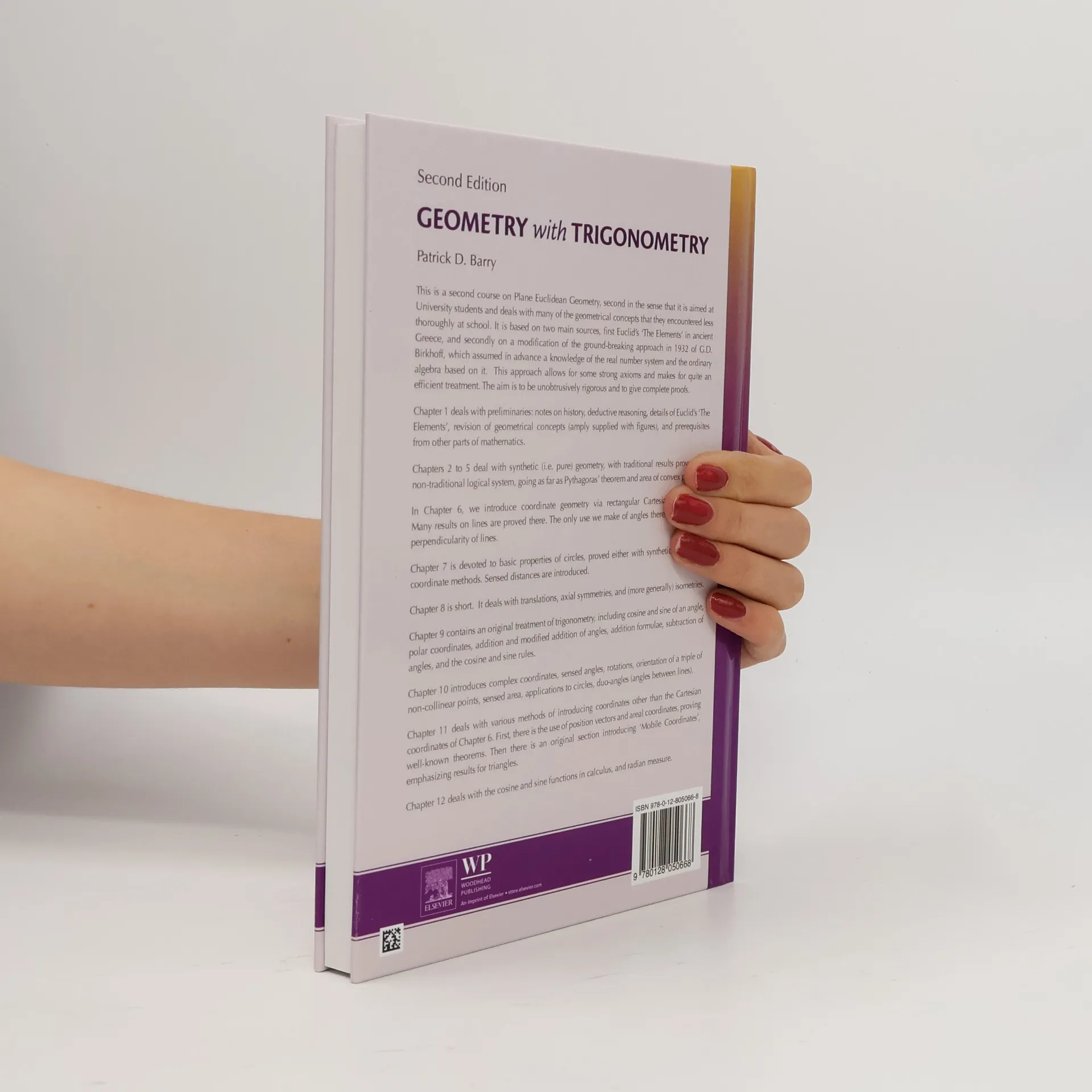
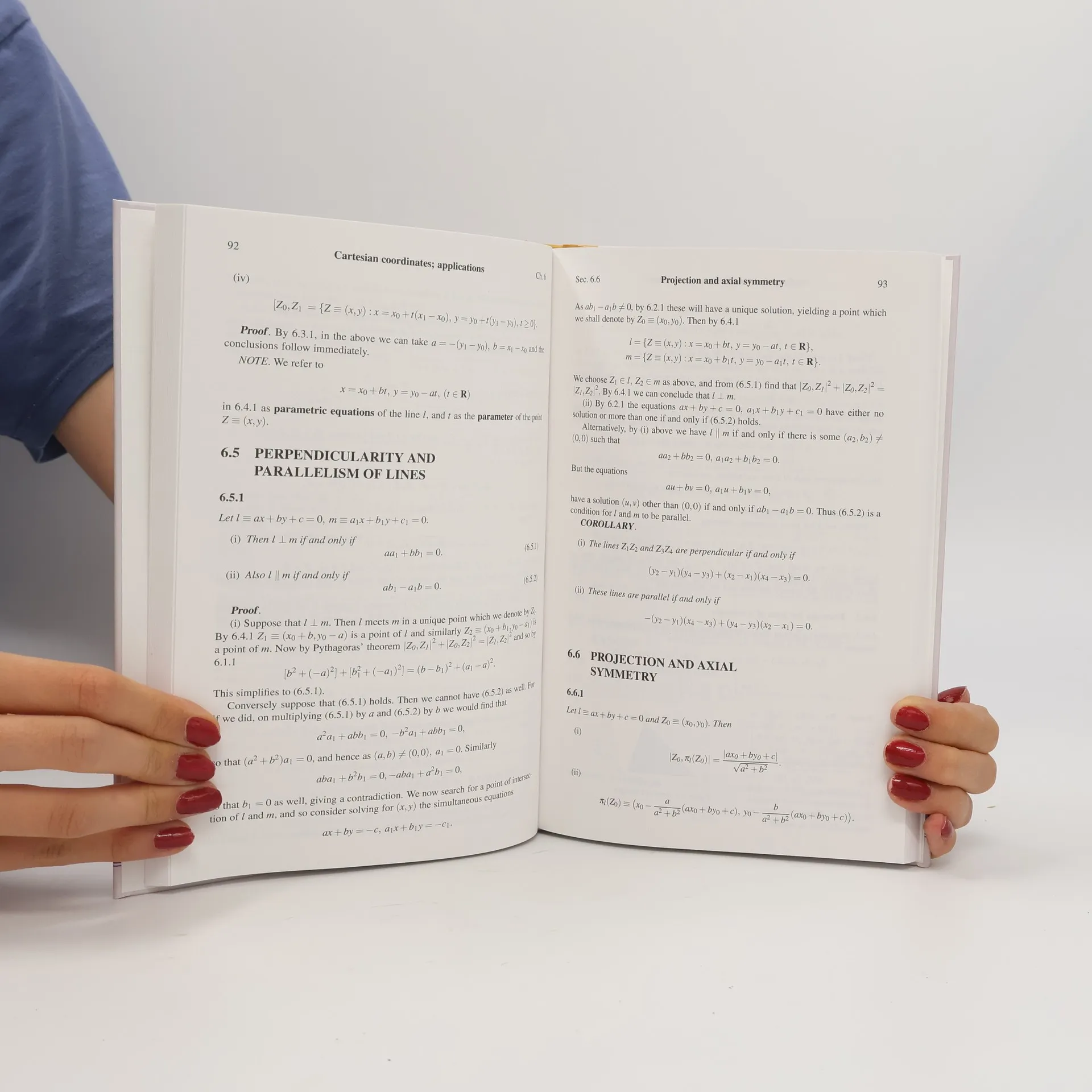
This second edition serves as a comprehensive course in plane Euclidean geometry, building on foundational concepts typically encountered in school. It begins with a substantial section of pure geometry in Chapters 2 to 5, where familiar results are efficiently proved, albeit through a non-traditional logical framework. Chapter 6 introduces coordinate geometry, utilizing angles solely to address the perpendicularity and parallelism of lines, developing Cartesian and parametric equations with various applications. Chapter 7 explores basic circle properties, mid-lines of angle supports, and sensed distances. Chapter 8 briefly covers translations, axial symmetries, and isometries. In Chapter 9, trigonometry is approached innovatively, allowing for the handling of clockwise and anticlockwise concepts beyond mere visual representation, setting the stage for calculus in Chapter 10, which introduces complex numbers as coordinates and their practical benefits. Various topics are discussed, including sensed angles and areas, as well as angles between lines. Chapter 11 establishes convenient methods for proving geometric results, including position vectors and mobile coordinates. Chapter 12 addresses trigonometric functions within a calculus context. This edition has been thoroughly revised over three years, correcting errors, improving proofs, and significantly extending Chapter 11, particularly regarding mobile coordinates.
Zakup książki
Geometry with Trigonometry, Patrick D. Barry
- Język

- Rok wydania
- 2015
- Oprawa
- (twarda)
Metody płatności
Nikt jeszcze nie ocenił.
- Tytuł
- Geometry with Trigonometry
- Podtytuł
- Second Edition
- Język
- angielski
- Autorzy
- Patrick D. Barry
- Wydawca
- Woodhead Publishing
- Rok wydania
- 2015
- Oprawa
- twarda
- Liczba stron
- 280
- ISBN10
- 0128050667
- ISBN13
- 9780128050668
- Seria
- Opis
- This second edition serves as a comprehensive course in plane Euclidean geometry, building on foundational concepts typically encountered in school. It begins with a substantial section of pure geometry in Chapters 2 to 5, where familiar results are efficiently proved, albeit through a non-traditional logical framework. Chapter 6 introduces coordinate geometry, utilizing angles solely to address the perpendicularity and parallelism of lines, developing Cartesian and parametric equations with various applications. Chapter 7 explores basic circle properties, mid-lines of angle supports, and sensed distances. Chapter 8 briefly covers translations, axial symmetries, and isometries. In Chapter 9, trigonometry is approached innovatively, allowing for the handling of clockwise and anticlockwise concepts beyond mere visual representation, setting the stage for calculus in Chapter 10, which introduces complex numbers as coordinates and their practical benefits. Various topics are discussed, including sensed angles and areas, as well as angles between lines. Chapter 11 establishes convenient methods for proving geometric results, including position vectors and mobile coordinates. Chapter 12 addresses trigonometric functions within a calculus context. This edition has been thoroughly revised over three years, correcting errors, improving proofs, and significantly extending Chapter 11, particularly regarding mobile coordinates.