

Więcej o książce
Early in this century, the discovery of x-ray diffraction by crystals revolutionized crystallography and the understanding of atomic structure, significantly advancing solid-state physics. Crystallographic techniques, especially x-ray diffraction analysis, have since permeated materials science, molecular physics, chemistry, and various other scientific fields. Subsequently, electron and neutron diffraction analyses emerged as vital tools, complementing x-ray data and providing deeper insights into atomic and real crystal structures. Modern investigative methods, including electron microscopy and various resonance techniques, have further enriched our understanding of atomic, electronic, and real crystal structures. The field of crystal physics has also seen vigorous growth, leading to the discovery of remarkable phenomena in crystals with practical applications. Key developments in crystallography included the theory of crystal growth, which linked it to thermodynamics and physical chemistry, and the advancement of synthetic crystal growth methods driven by practical needs. The rise of man-made crystals has profoundly influenced traditional sectors such as materials processing, precision instrument manufacturing, and the jewelry industry, marking a significant shift in technological applications.
Zakup książki
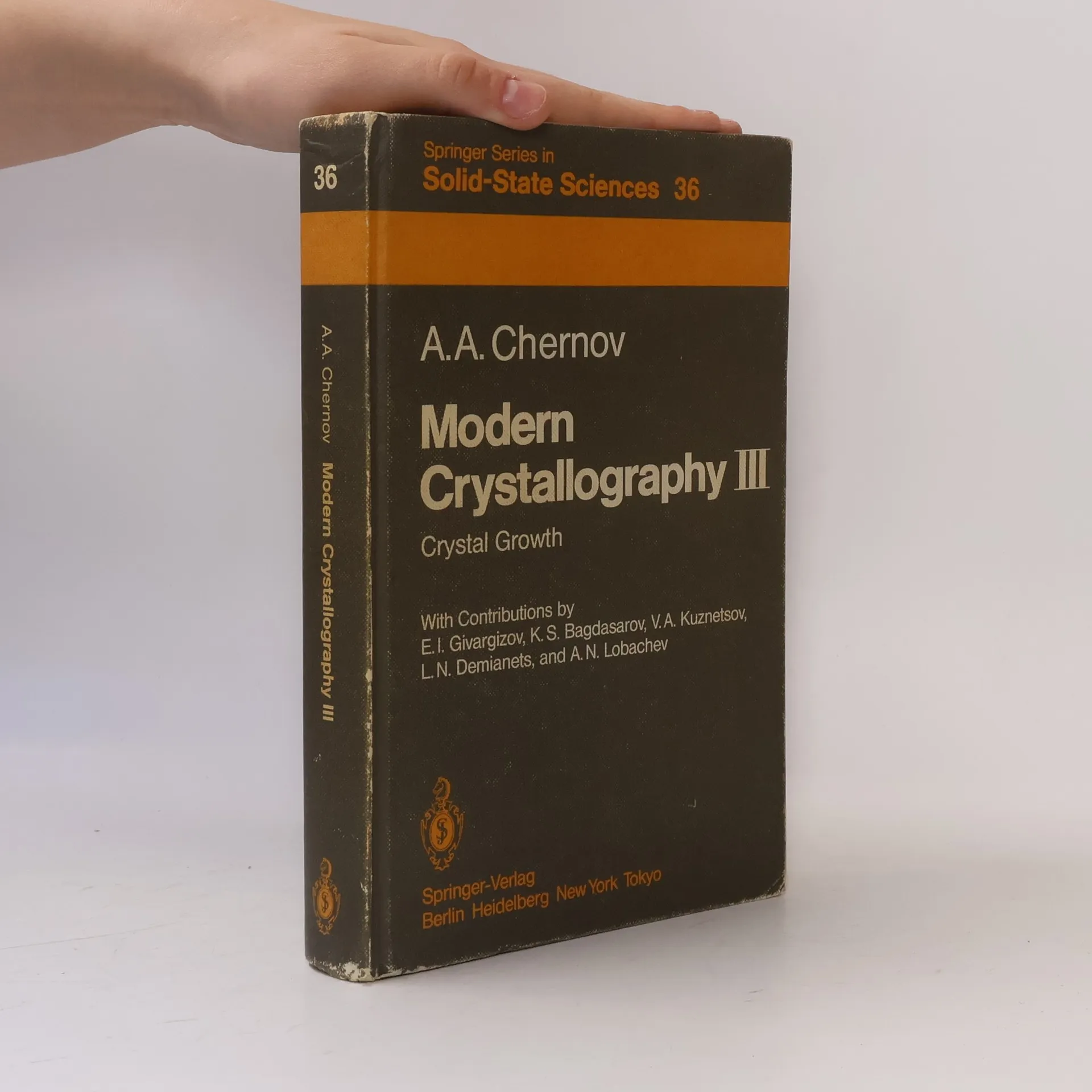
Springer Series in Solid-State Sciences - 36: Modern Crystallography III, Alexander A. Chernov, K.S. Bagdasarov, E.I. Givargizov, V.A. Kuznetsov, L.N. Demianets, A.N. Lobachev
- Język

- Rok wydania
- 1984
- Oprawa
- (twarda)
Metody płatności
Nikt jeszcze nie ocenił.
- Tytuł
- Springer Series in Solid-State Sciences - 36: Modern Crystallography III
- Podtytuł
- Crystal Growth
- Język
- angielski
- Autorzy
- Alexander A. Chernov, K.S. Bagdasarov, E.I. Givargizov, V.A. Kuznetsov, L.N. Demianets, A.N. Lobachev
- Wydawca
- Springer
- Rok wydania
- 1984
- Oprawa
- twarda
- Liczba stron
- 537
- ISBN10
- 3540115161
- ISBN13
- 9783540115168
- Seria
- Tagi
- Nauki przyrodnicze, Nauka, Technologia, Chemia nieorganiczna, Chemia Fizyczna, Fizyka & Astronomia, Termodynamika, Krystalografia
- Opis
- Early in this century, the discovery of x-ray diffraction by crystals revolutionized crystallography and the understanding of atomic structure, significantly advancing solid-state physics. Crystallographic techniques, especially x-ray diffraction analysis, have since permeated materials science, molecular physics, chemistry, and various other scientific fields. Subsequently, electron and neutron diffraction analyses emerged as vital tools, complementing x-ray data and providing deeper insights into atomic and real crystal structures. Modern investigative methods, including electron microscopy and various resonance techniques, have further enriched our understanding of atomic, electronic, and real crystal structures. The field of crystal physics has also seen vigorous growth, leading to the discovery of remarkable phenomena in crystals with practical applications. Key developments in crystallography included the theory of crystal growth, which linked it to thermodynamics and physical chemistry, and the advancement of synthetic crystal growth methods driven by practical needs. The rise of man-made crystals has profoundly influenced traditional sectors such as materials processing, precision instrument manufacturing, and the jewelry industry, marking a significant shift in technological applications.