

Więcej o książce
These twenty lectures, developed by Professor Siebert over two decades at MIT, aim to familiarize students with essential analytical tools in Signals and Systems. The lectures explore the application of these tools to understand key concepts and devices in modern communication and control engineering. They also delve into the mathematical foundations, powers, and limitations of these tools, while establishing a common vocabulary and framework for signal and system theory. While organized as lectures, the content includes a wealth of additional topics, examples, unusual problems, and laboratory exercises not typically covered in oral presentations. The material builds on knowledge from earlier courses in electrical circuits and differential equations. Key subjects include the classical formulation of dynamic equations for electrical circuits, the unilateral Laplace transform and its applications, system functions, poles and zeros, interconnected systems, feedback dynamics, discrete-time signals, and linear difference equations. Further topics encompass the unilateral Z-transform, unit-sample response, convolutional representations, frequency-domain methods for LTI systems, Fourier series, transforms, sampling, filters, and the uncertainty principle. The lectures also address bandpass operations, analog communication systems, Fourier transforms in discrete-time systems, and random signals, culminating in a comprehensive overv
Zakup książki
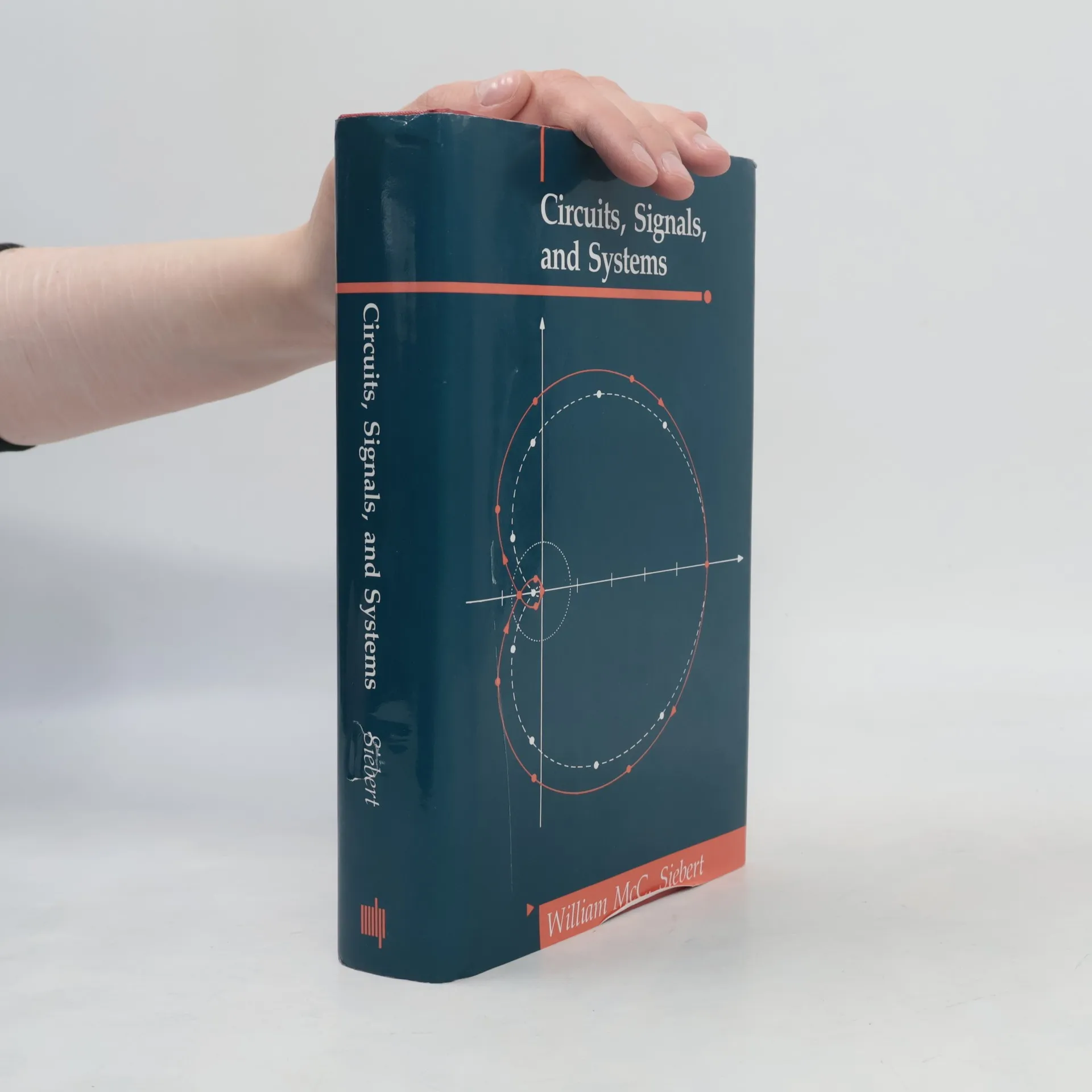
Circuits, Signals, and Systems, William McC. Siebert
- Język

- Rok wydania
- 1985
- Oprawa
- (twarda)
Metody płatności
Nikt jeszcze nie ocenił.
- Tytuł
- Circuits, Signals, and Systems
- Język
- angielski
- Autorzy
- William McC. Siebert
- Wydawca
- MIT Press
- Rok wydania
- 1985
- Oprawa
- twarda
- Liczba stron
- 669
- ISBN10
- 0262192292
- ISBN13
- 9780262192293
- Seria
- Kategorie
- Tagi
- Opis
- These twenty lectures, developed by Professor Siebert over two decades at MIT, aim to familiarize students with essential analytical tools in Signals and Systems. The lectures explore the application of these tools to understand key concepts and devices in modern communication and control engineering. They also delve into the mathematical foundations, powers, and limitations of these tools, while establishing a common vocabulary and framework for signal and system theory. While organized as lectures, the content includes a wealth of additional topics, examples, unusual problems, and laboratory exercises not typically covered in oral presentations. The material builds on knowledge from earlier courses in electrical circuits and differential equations. Key subjects include the classical formulation of dynamic equations for electrical circuits, the unilateral Laplace transform and its applications, system functions, poles and zeros, interconnected systems, feedback dynamics, discrete-time signals, and linear difference equations. Further topics encompass the unilateral Z-transform, unit-sample response, convolutional representations, frequency-domain methods for LTI systems, Fourier series, transforms, sampling, filters, and the uncertainty principle. The lectures also address bandpass operations, analog communication systems, Fourier transforms in discrete-time systems, and random signals, culminating in a comprehensive overv