




Więcej o książce
About 120 years ago, James Clerk Maxwell introduced his famous hypothetical demon, challenging the second law of thermodynamics. This concept has intrigued scientists across various fields, including statistical and quantum physics, information theory, and computer science. The demon's allure has drawn interest from physical scientists, engineers, computer scientists, biologists, psychologists, and historians of science. Until now, essential source materials have been dispersed in various journals. This book compiles twenty-five reprints, featuring foundational works by Maxwell and William Thomson, historical reviews by Martin Klein, Edward Daub, and Peter Heimann, and contributions from Leo Szilard, Leon Brillouin, Dennis Gabor, and Jerome Rothstein on information theory. It also includes innovations by Rolf Landauer and Charles Bennett that connect the demon to computational limits. An introductory chapter traces the demon's evolution, from Maxwell's depiction of the second law's statistical nature to recent insights regarding the need to erase its memory. Additionally, an annotated chronological bibliography is provided. Originally published in 1990, this edition from the Princeton Legacy Library utilizes modern print-on-demand technology to make previously out-of-print works accessible, preserving their original texts in durable formats. The initiative aims to enhance access to the scholarly heritage of Princeton Universit
Zakup książki
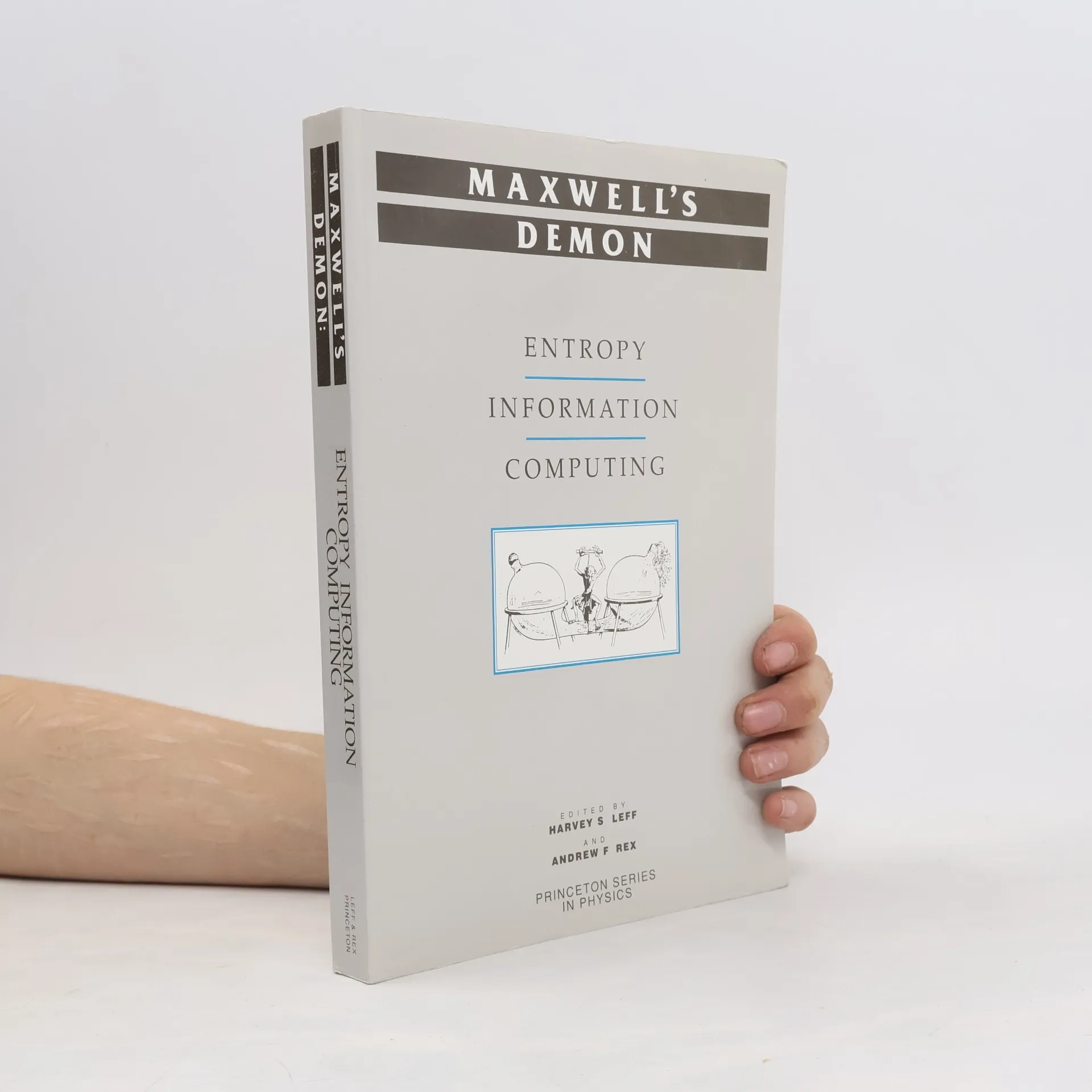
Maxwell's Demon, Harvey S. Leff, Andrew F. Rex
- Język

- Rok wydania
- 1990
- Oprawa
- (miękka)
Metody płatności
Nikt jeszcze nie ocenił.
- Tytuł
- Maxwell's Demon
- Podtytuł
- Entropy, Information, Computing
- Język
- angielski
- Autorzy
- Harvey S. Leff, Andrew F. Rex
- Wydawca
- Princeton University Press
- Rok wydania
- 1990
- Oprawa
- miękka
- Liczba stron
- 349
- ISBN10
- 069108727X
- ISBN13
- 9780691087276
- Seria
- Tagi
- Nauki przyrodnicze, Nauka
- Opis
- About 120 years ago, James Clerk Maxwell introduced his famous hypothetical demon, challenging the second law of thermodynamics. This concept has intrigued scientists across various fields, including statistical and quantum physics, information theory, and computer science. The demon's allure has drawn interest from physical scientists, engineers, computer scientists, biologists, psychologists, and historians of science. Until now, essential source materials have been dispersed in various journals. This book compiles twenty-five reprints, featuring foundational works by Maxwell and William Thomson, historical reviews by Martin Klein, Edward Daub, and Peter Heimann, and contributions from Leo Szilard, Leon Brillouin, Dennis Gabor, and Jerome Rothstein on information theory. It also includes innovations by Rolf Landauer and Charles Bennett that connect the demon to computational limits. An introductory chapter traces the demon's evolution, from Maxwell's depiction of the second law's statistical nature to recent insights regarding the need to erase its memory. Additionally, an annotated chronological bibliography is provided. Originally published in 1990, this edition from the Princeton Legacy Library utilizes modern print-on-demand technology to make previously out-of-print works accessible, preserving their original texts in durable formats. The initiative aims to enhance access to the scholarly heritage of Princeton Universit