

Bookbot

Nik Cornish

    Kursk
    The Russian Army and the First World War
    Berlin
    The Russian Army 1914–18
    • Berlin

      • 144 strony
      • 6 godzin czytania

      In April and May 1945 the city of Berlin was the site of the final destructive act of the Second World War in Europe. The German capital became a battleground. After three weeks of ruthless fighting against a desperate, sometimes suicidal, defense, the Red Army took the city and crushed the last remaining German armies in the East. This momentous battle and the elaborate preparations for it were recorded in graphic detail by photographers whose images have come down to us today. These images, which give us an unforgettable glimpse into the grim reality of mid-twentieth-century warfare, are the raw material of Nik Cornish’s evocative book.Using a rich selection of rare photographs from the Russian archives as well as images from German sources, most of which have not been published before, he traces the course of the entire campaign. The battles fought in East Prussia, eastern Germany and Hungary – in particular the assault on Budapest – are covered. But the body of his book is devoted to the battle for Berlin itself - the monstrous onslaught launched by Zhukov’s armies on the Seelow Heights, the bitter street fighting through the suburbs, then the ultimate confrontation, the merciless room-by-room struggle for the center of the city and the Reichstag.

      Berlin2010
      3,8
    • This book is a clear introduction to the Russian Army of 1914–18 and the events on the Eastern Front during that period. It covers not only the three dominant events of Western literature (the battle of Tannenberg and the March and November revolutions) but expands on the facts and bitter realities of the horrific warfare that challenged Russia and all the nations. It contains many previously unpublished photographs depicting the Russian Army of that time. The author dispels some of the myths that have grown up around the army of the last Tsar, such as a lack of innovation and an inability to adapt to "modern" warfare. It also shows there was more to the Eastern Front than Tannenberg and the revolutions of 1917. Covered in this book are areas glossed over by other writers such as the nationalist formations and the Revolutionary units of the Provisional Government. Two chapters describe the Romanian and Caucasian theatres in more depth than usual.

      The Russian Army and the First World War2006
    • Kursk

      History's Greatest Tank Battle

      • 224 strony
      • 8 godzin czytania

      A lavshly illustrated book of the greatest tank battle in history. Covers all aspects of the battle using around 300 photographs, the majority of which are sourced from Russian archives. Cornish does a great job being the expert he is on the Red Army in World War 2. Of particular interest, I found, were the first hand accounts from Russian and German soldiers that were actually there during the fierce fighting on the Eastern Front.

      Kursk2005
    • The Russian Army 1914–18

      • 48 stron
      • 2 godziny czytania

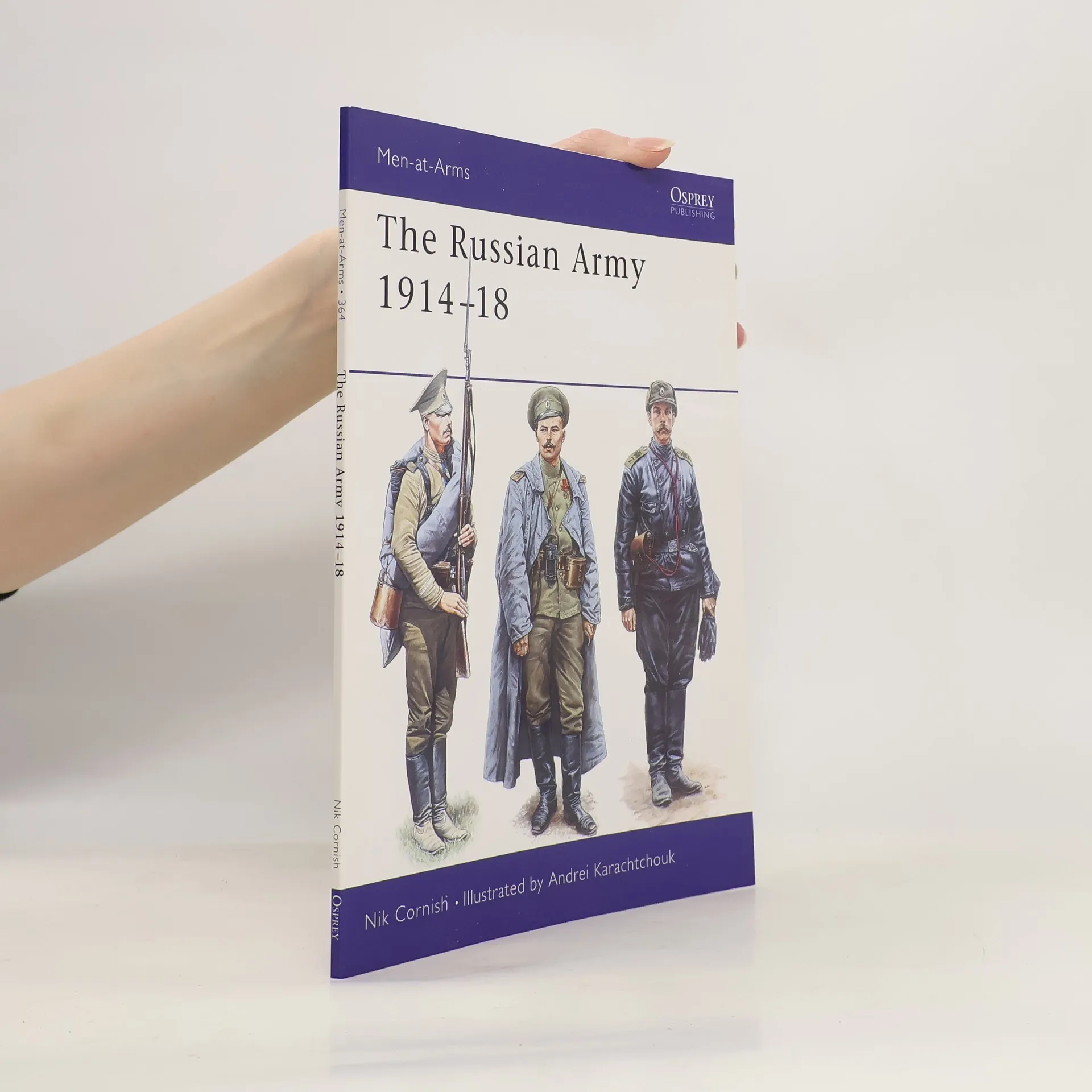
      Often overshadowed by the drama of its catastrophic collapse in the November 1917 Revolution, the Imperial Russian Army's record in 1914-16 included some notable victories. Its human qualities of patriotism and endurance were remarkable, and in 1916 the 'Brusilov Offensive' on the South-Western Front outdistanced anything that was being achieved in France. The variety and romance of its uniforms - infantry and cavalry, Guards and Line, Cossacks, armour and Air Service crewmen, even a priest - are splendidly captured here by Russia's leading military artist; and Nik Cornish's expert text is supported by tables of insignia and many rare photographs.

      The Russian Army 1914–182001
      4,0