






Więcej o książce
Conventional wisdom suggests that the sciences provide a value-free method for understanding the natural world. However, Helen Longino argues that general accounts of scientific methodology cannot support this belief, given the social and normative dimensions of scientific debates. She focuses on the concept of evidence, asserting that a robust methodology cannot eliminate the influence of social and cultural values in shaping knowledge. Longino proposes that the objectivity of scientific inquiry can be preserved by viewing it as a social process rather than an individual one. By fostering dialogue between methodologists and social critics, she introduces "contextual empiricism" through an analysis of research programs criticized by feminists. Longino examines theories related to human evolution, prenatal hormonal influences on gender behavior, sex differences in cognition, and sexual orientation, highlighting how socially laden assumptions affect data description, presentation, and interpretation. She particularly notes that research on the hormonal basis of sex-differentiated behavior is rooted in assumptions about gender relations and human agency. Longino concludes with a discussion of the interplay between science, values, and ideology, drawing on the works of Habermas, Foucault, Keller, and Haraway.
Zakup książki
Science as Social Knowledge, Helen E. Longino
- Język

- Rok wydania
- 1990
- Oprawa
- (twarda)
Metody płatności
Nikt jeszcze nie ocenił.
- Tytuł
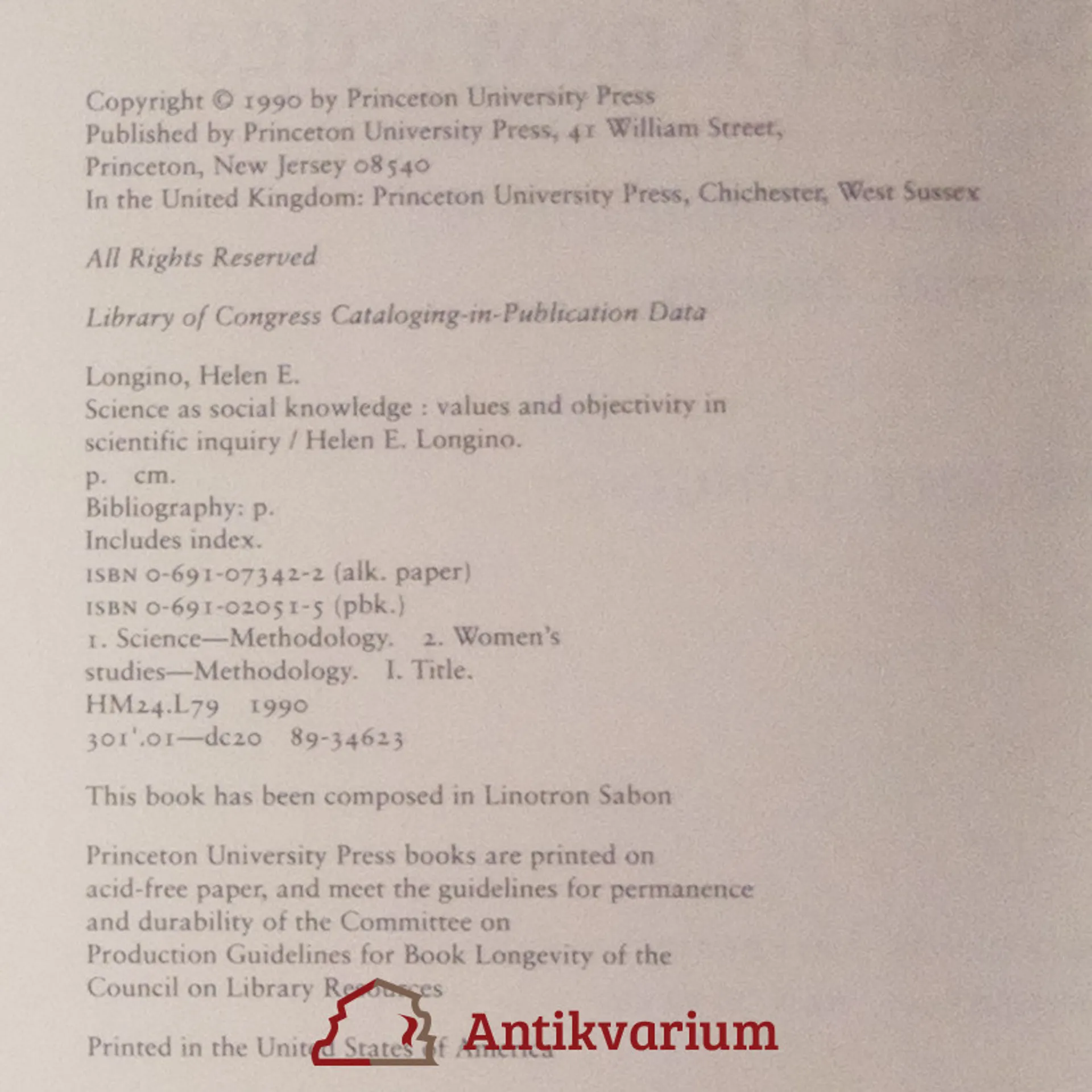
- Science as Social Knowledge
- Język
- angielski
- Autorzy
- Helen E. Longino
- Wydawca
- Princeton University Press
- Rok wydania
- 1990
- Oprawa
- twarda
- ISBN10
- 0691073422
- ISBN13
- 9780691073422
- Seria
- Kategorie
- Tagi
- Nauka, Technologia, Feminizm
- Opis
- Conventional wisdom suggests that the sciences provide a value-free method for understanding the natural world. However, Helen Longino argues that general accounts of scientific methodology cannot support this belief, given the social and normative dimensions of scientific debates. She focuses on the concept of evidence, asserting that a robust methodology cannot eliminate the influence of social and cultural values in shaping knowledge. Longino proposes that the objectivity of scientific inquiry can be preserved by viewing it as a social process rather than an individual one. By fostering dialogue between methodologists and social critics, she introduces "contextual empiricism" through an analysis of research programs criticized by feminists. Longino examines theories related to human evolution, prenatal hormonal influences on gender behavior, sex differences in cognition, and sexual orientation, highlighting how socially laden assumptions affect data description, presentation, and interpretation. She particularly notes that research on the hormonal basis of sex-differentiated behavior is rooted in assumptions about gender relations and human agency. Longino concludes with a discussion of the interplay between science, values, and ideology, drawing on the works of Habermas, Foucault, Keller, and Haraway.