






Więcej o książce
Giorgio Agamben is a prominent thinker in contemporary Italy, and "The Coming Community" is a significant addition to his philosophical contributions. The text poses critical questions about the formation of a human community that does not adhere to specific identities, such as nationality or religion. Agamben investigates how a community can consist of singularities that reject conventional criteria for belonging. He draws from a diverse array of sources, including St. Thomas' analysis of halos, a French commercial, Talmudic warnings about paradise, and the collective power demonstrated during Tiananmen Square. Through this exploration, he identifies a new form of singular subjectivity that is emerging in today's world. Agamben's work develops the concept of community and its social implications, offering a philosophical foundation for ethics that transcends traditional notions of subjectivity, ideology, and morality. His inquiry serves as a contemporary response to influential thinkers like Heidegger, Wittgenstein, and Plato, while also engaging with various historical and philosophical traditions. This volume initiates a series aimed at fostering transdisciplinary dialogue, challenging established boundaries across disciplines, nations, genders, races, and technologies. Agamben teaches philosophy in Paris and Italy and has authored several notable works in cultural and literary theory.

Zakup książki
The Coming Community, Giorgio Agamben
- Język

- Rok wydania
- 2009
- Oprawa
- (miękka)
Metody płatności
Brakuje nam tutaj Twojej recenzji.
- Tytuł
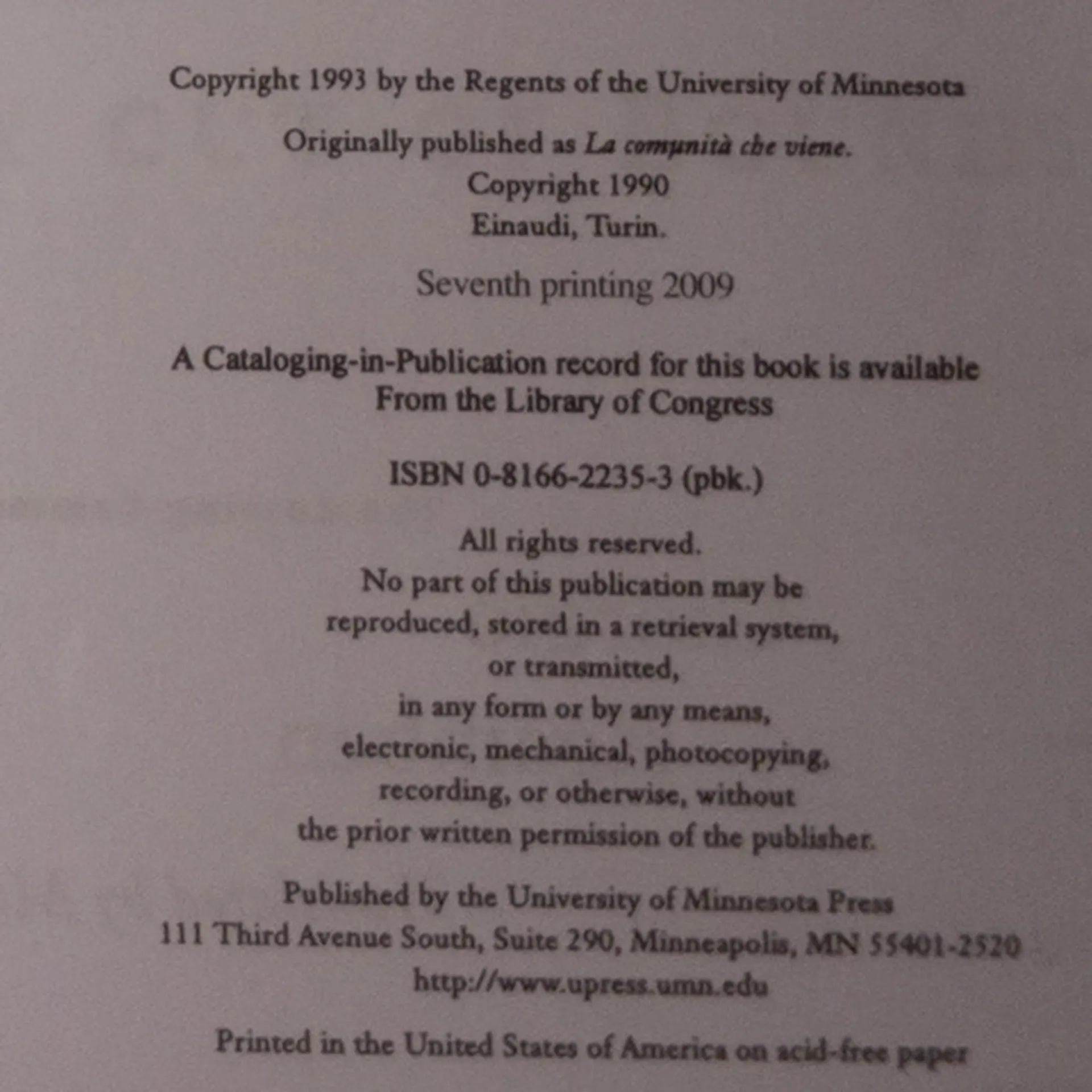
- The Coming Community
- Język
- angielski
- Autorzy
- Giorgio Agamben
- Wydawca
- U of Minnesota Press
- Rok wydania
- 2009
- Oprawa
- miękka
- ISBN10
- 0816622353
- ISBN13
- 9780816622351
- Seria
- Kategorie
- Tagi
- Tematy religijne, Tematyka filozoficzna, Polityka, Teologia, Południowa Europa, Włochy, Literatura włoska, Teorie naukowe
- Ocena
- 4,05 z 5
- Opis
- Giorgio Agamben is a prominent thinker in contemporary Italy, and "The Coming Community" is a significant addition to his philosophical contributions. The text poses critical questions about the formation of a human community that does not adhere to specific identities, such as nationality or religion. Agamben investigates how a community can consist of singularities that reject conventional criteria for belonging. He draws from a diverse array of sources, including St. Thomas' analysis of halos, a French commercial, Talmudic warnings about paradise, and the collective power demonstrated during Tiananmen Square. Through this exploration, he identifies a new form of singular subjectivity that is emerging in today's world. Agamben's work develops the concept of community and its social implications, offering a philosophical foundation for ethics that transcends traditional notions of subjectivity, ideology, and morality. His inquiry serves as a contemporary response to influential thinkers like Heidegger, Wittgenstein, and Plato, while also engaging with various historical and philosophical traditions. This volume initiates a series aimed at fostering transdisciplinary dialogue, challenging established boundaries across disciplines, nations, genders, races, and technologies. Agamben teaches philosophy in Paris and Italy and has authored several notable works in cultural and literary theory.