



Więcej o książce
Briefly, we review the basic elements of computability theory and prob ability theory that are required. Finally, in order to place the subject in the appropriate historical and conceptual context we trace the main roots of Kolmogorov complexity. This way the stage is set for Chapters 2 and 3, where we introduce the notion of optimal effective descriptions of objects. The length of such a description (or the number of bits of information in it) is its Kolmogorov complexity. We treat all aspects of the elementary mathematical theory of Kolmogorov complexity. This body of knowledge may be called algo rithmic complexity theory. The theory of Martin-Lof tests for random ness of finite objects and infinite sequences is inextricably intertwined with the theory of Kolmogorov complexity and is completely treated. We also investigate the statistical properties of finite strings with high Kolmogorov complexity. Both of these topics are eminently useful in the applications part of the book. We also investigate the recursion theoretic properties of Kolmogorov complexity (relations with Godel's incompleteness result), and the Kolmogorov complexity version of infor mation theory, which we may call "algorithmic information theory" or "absolute information theory. " The treatment of algorithmic probability theory in Chapter 4 presup poses Sections 1. 6, 1. 11. 2, and Chapter 3 (at least Sections 3. 1 through 3. 4).


Zakup książki
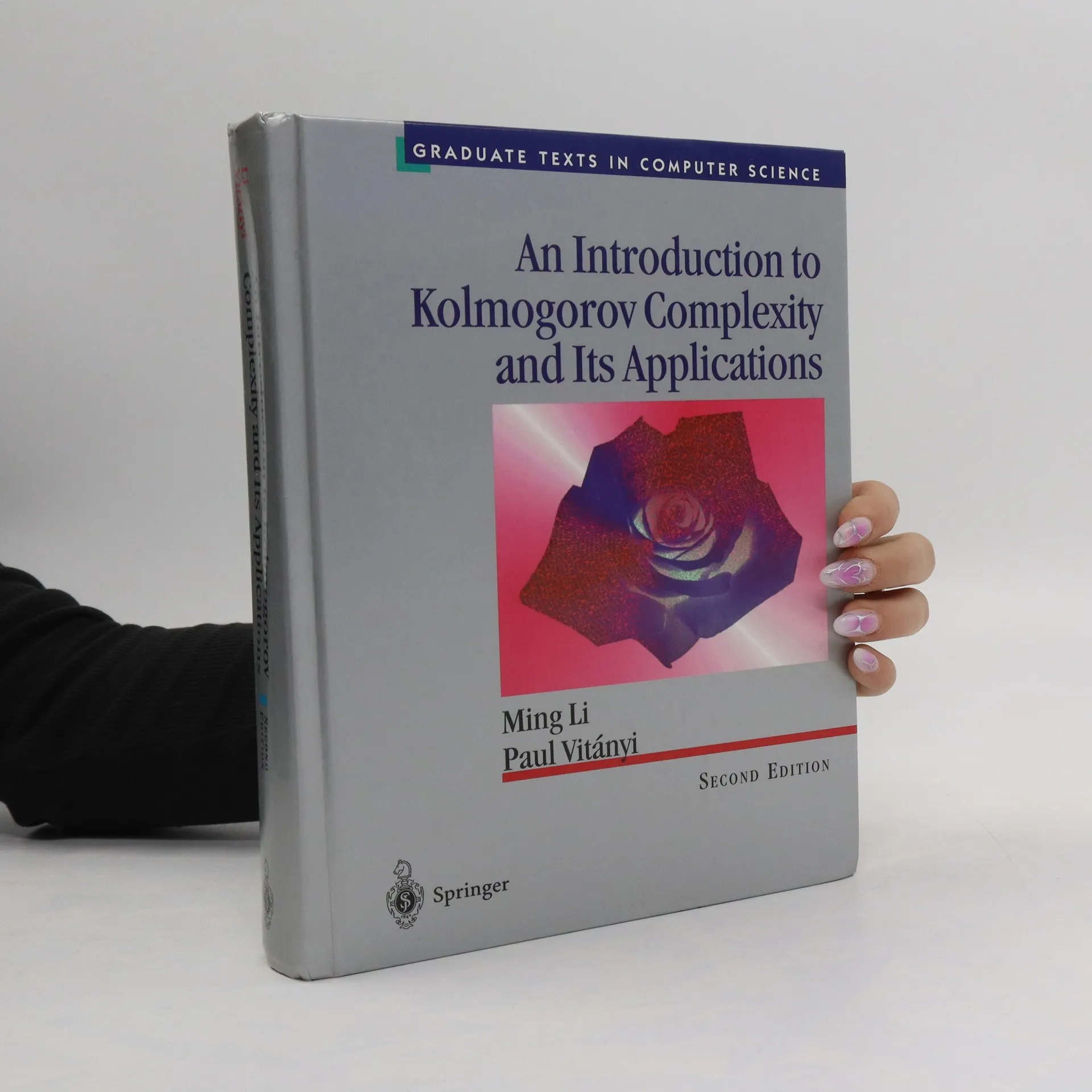
An introduction to Kolmogorov complexity and its applications, Paul M.B. Vitányi, Ming Li
- Język

- Rok wydania
- 1997
- Oprawa
- (twarda)
Metody płatności
Brakuje nam tutaj Twojej recenzji.
- Tytuł
- An introduction to Kolmogorov complexity and its applications
- Język
- angielski
- Autorzy
- Paul M.B. Vitányi, Ming Li
- Wydawca
- Springer
- Rok wydania
- 1997
- Oprawa
- twarda
- ISBN10
- 0387948686
- ISBN13
- 9780387948683
- Seria
- Kategorie
- Ocena
- 3,95 z 5
- Opis
- Briefly, we review the basic elements of computability theory and prob ability theory that are required. Finally, in order to place the subject in the appropriate historical and conceptual context we trace the main roots of Kolmogorov complexity. This way the stage is set for Chapters 2 and 3, where we introduce the notion of optimal effective descriptions of objects. The length of such a description (or the number of bits of information in it) is its Kolmogorov complexity. We treat all aspects of the elementary mathematical theory of Kolmogorov complexity. This body of knowledge may be called algo rithmic complexity theory. The theory of Martin-Lof tests for random ness of finite objects and infinite sequences is inextricably intertwined with the theory of Kolmogorov complexity and is completely treated. We also investigate the statistical properties of finite strings with high Kolmogorov complexity. Both of these topics are eminently useful in the applications part of the book. We also investigate the recursion theoretic properties of Kolmogorov complexity (relations with Godel's incompleteness result), and the Kolmogorov complexity version of infor mation theory, which we may call "algorithmic information theory" or "absolute information theory. " The treatment of algorithmic probability theory in Chapter 4 presup poses Sections 1. 6, 1. 11. 2, and Chapter 3 (at least Sections 3. 1 through 3. 4).