



Parametry
- 203 strony
- 8 godzin czytania
Więcej o książce
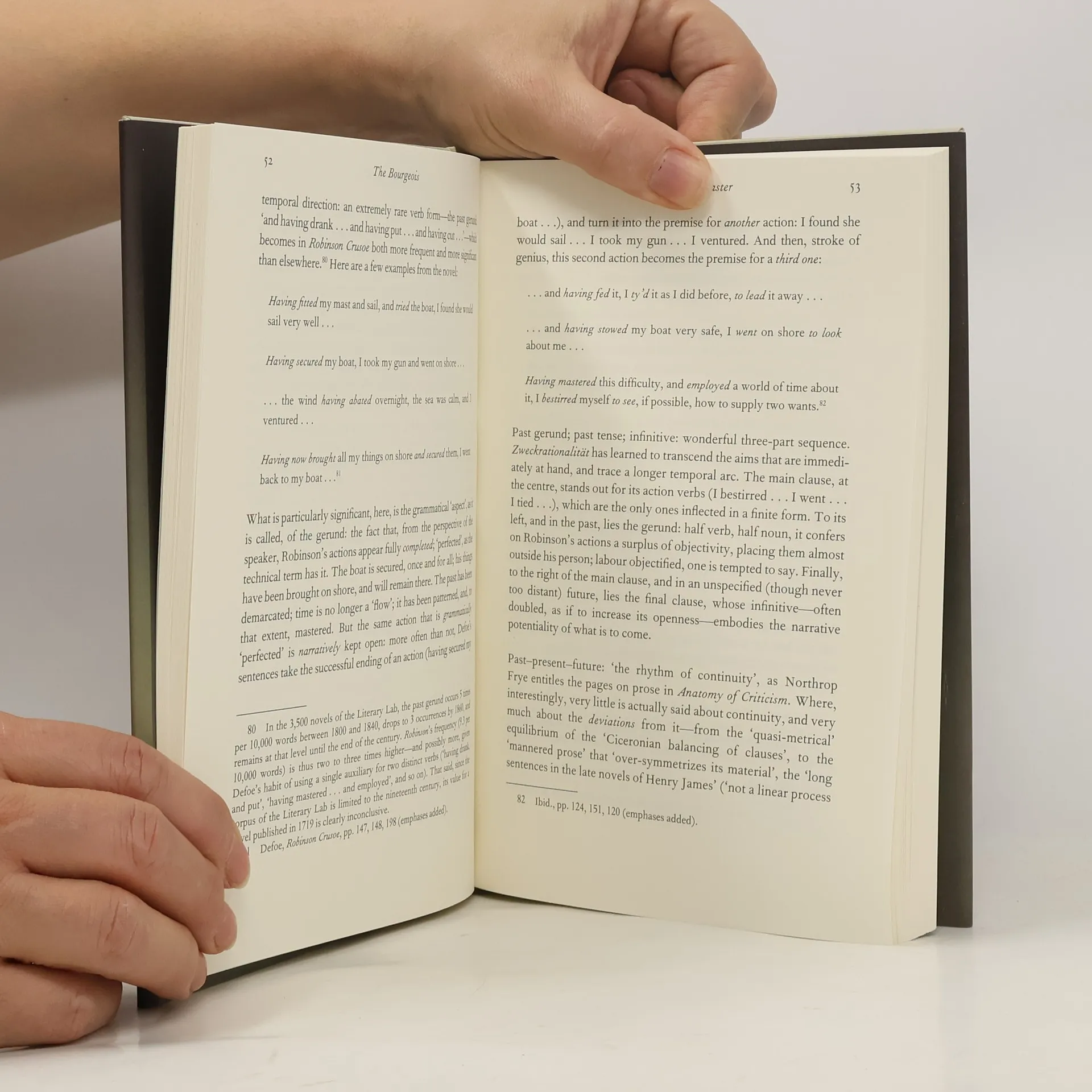
"The bourgeois ... Not so long ago, this notion seemed indispensable to social analysis; these days, one might go years without hearing it mentioned. Capitalism is more powerful than ever, but its human embodiment seems to have vanished. 'I am a member of the bourgeois class, feel myself to be such, and have been brought up on its opinions and ideals,' wrote Max Weber, in 1895. Who could repeat these words today? Bourgeois 'opinions and ideals' -- what are they?" Thus begins Franco Moretti's study of the bourgeois in modern European literature -- a major new analysis of the once-dominant culture and its literary decline and fall. Moretti's gallery of individual portraits is entwined with the analysis of specific keywords -- "useful" and "earnest," "efficiency," "influence," "comfort," "roba"-- and of the formal mutations of the medium of prose. From the "working master" of the opening chapter, through the seriousness of nineteenth-century novels, the conservative hegemony of Victorian Britain, the "national malformations" of the Southern and Eastern periphery, and the radical self-critique of Ibsen's twelve-play cycle, the book charts the vicissitudes of bourgeois culture, exploring the causes for its historical weakness, and for its current irrelevance. -- Publisher's website.

Zakup książki
The Bourgeois: Between History and Literature, Franco Moretti
- Język

- Rok wydania
- 2013
- Oprawa
- (twarda)
Metody płatności
Brakuje nam tutaj Twojej recenzji.
- Tytuł
- The Bourgeois: Between History and Literature
- Język
- angielski
- Autorzy
- Franco Moretti
- Wydawca
- Verso Books
- Rok wydania
- 2013
- Oprawa
- twarda
- Liczba stron
- 203
- ISBN10
- 178168085X
- ISBN13
- 9781781680858
- Seria
- Kategorie
- Oryginalna nazwa
- The bourgeois
- Ocena
- 4,1 z 5
- Opis
- "The bourgeois ... Not so long ago, this notion seemed indispensable to social analysis; these days, one might go years without hearing it mentioned. Capitalism is more powerful than ever, but its human embodiment seems to have vanished. 'I am a member of the bourgeois class, feel myself to be such, and have been brought up on its opinions and ideals,' wrote Max Weber, in 1895. Who could repeat these words today? Bourgeois 'opinions and ideals' -- what are they?" Thus begins Franco Moretti's study of the bourgeois in modern European literature -- a major new analysis of the once-dominant culture and its literary decline and fall. Moretti's gallery of individual portraits is entwined with the analysis of specific keywords -- "useful" and "earnest," "efficiency," "influence," "comfort," "roba"-- and of the formal mutations of the medium of prose. From the "working master" of the opening chapter, through the seriousness of nineteenth-century novels, the conservative hegemony of Victorian Britain, the "national malformations" of the Southern and Eastern periphery, and the radical self-critique of Ibsen's twelve-play cycle, the book charts the vicissitudes of bourgeois culture, exploring the causes for its historical weakness, and for its current irrelevance. -- Publisher's website.