



Więcej o książce
Two world-renowned scientists present an audacious new vision of the cosmos that challenges the Big Bang theory. This widely accepted explanation for the universe's origin suggests that space and time began about 14 billion years ago in a hot, expanding fireball. Over the past three decades, the theory has undergone numerous revisions to address questions regarding the formation of galaxies and stars, as well as the accelerating expansion of the universe. However, the cause of the Big Bang remains unexplained. In their groundbreaking work, Paul J. Steinhardt and Neil Turok introduce a bold cosmology that posits the moment of creation as part of an infinite cycle of colossal collisions between our universe and a parallel world. They explore significant advancements in astronomy, particle physics, and superstring theory that underpin their “Cyclic Universe” theory. This perspective suggests that the Big Bang was not the beginning of time but a transition to a past characterized by endlessly repeating cycles of evolution, each generating new matter and forming new galaxies, stars, and planets. Their work addresses longstanding issues with the Big Bang model and offers a provocative new understanding of the cosmos's past and future, presenting a theory that could potentially solve cosmic mysteries.


Zakup książki
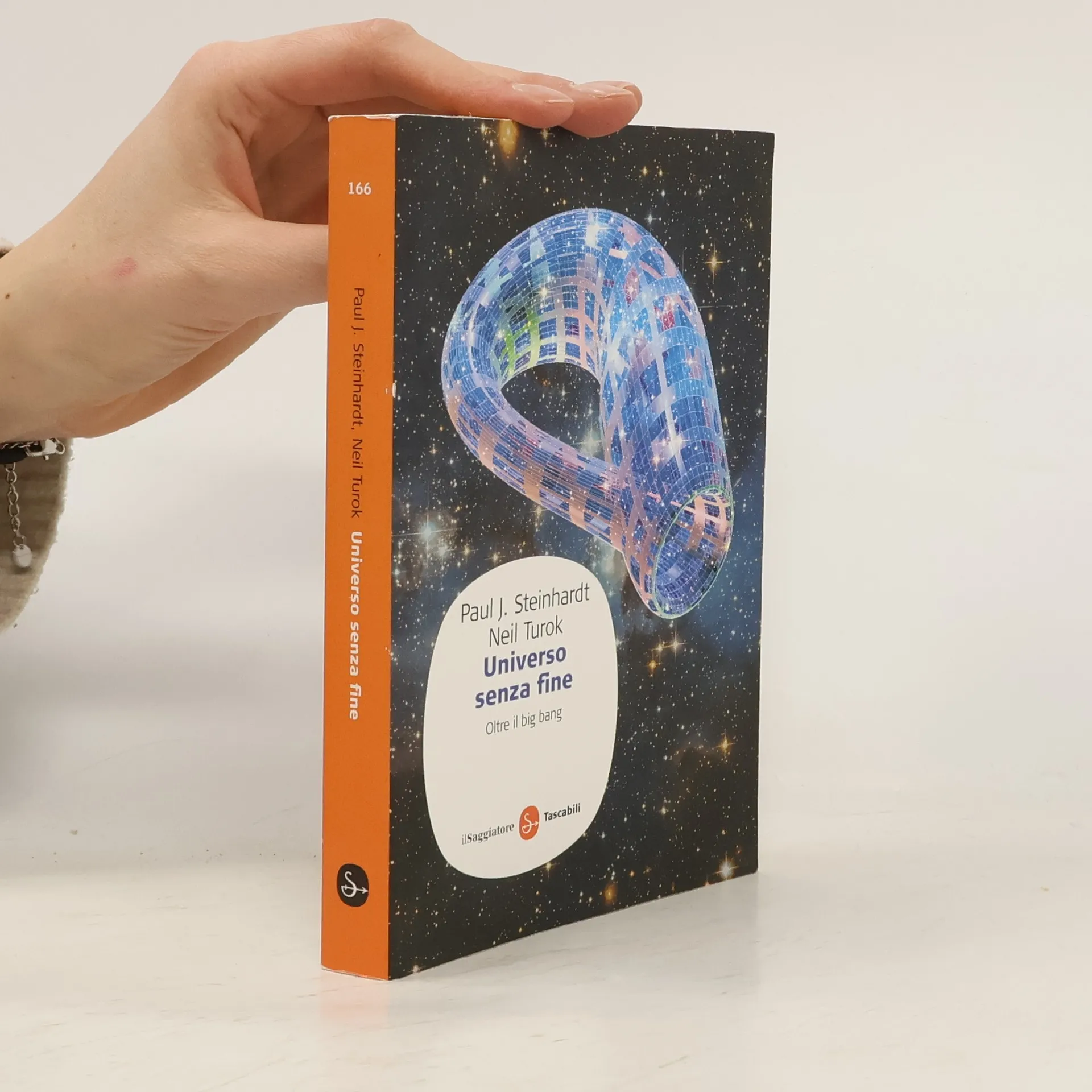
Universo senza fine, Paul J. Steinhardt, Neil Turok
- Język

- Rok wydania
- 2010
- Oprawa
- (miękka)
Metody płatności
Brakuje nam tutaj Twojej recenzji.
- Tytuł
- Universo senza fine
- Podtytuł
- Oltre il Big Bang
- Język
- włoski
- Autorzy
- Paul J. Steinhardt, Neil Turok
- Wydawca
- Il Saggiatore
- Rok wydania
- 2010
- Oprawa
- miękka
- Liczba stron
- 294
- ISBN10
- 8856502046
- ISBN13
- 9788856502046
- Seria
- Kategorie
- Tagi
- Tematy historyczne, Nauki przyrodnicze, Tematyka filozoficzna, Nauka, Kosmos, Przyszłość, Kosmologia, Powstanie wszechświata, Teoria strun, Cykliczny czas, Teoria Ujednania
- Pierwsze wydanie
- 2007
- Oryginalna nazwa
- Endless Universe: Beyond the Big Bang
- Ocena
- 3,95 z 5
- Opis
- Two world-renowned scientists present an audacious new vision of the cosmos that challenges the Big Bang theory. This widely accepted explanation for the universe's origin suggests that space and time began about 14 billion years ago in a hot, expanding fireball. Over the past three decades, the theory has undergone numerous revisions to address questions regarding the formation of galaxies and stars, as well as the accelerating expansion of the universe. However, the cause of the Big Bang remains unexplained. In their groundbreaking work, Paul J. Steinhardt and Neil Turok introduce a bold cosmology that posits the moment of creation as part of an infinite cycle of colossal collisions between our universe and a parallel world. They explore significant advancements in astronomy, particle physics, and superstring theory that underpin their “Cyclic Universe” theory. This perspective suggests that the Big Bang was not the beginning of time but a transition to a past characterized by endlessly repeating cycles of evolution, each generating new matter and forming new galaxies, stars, and planets. Their work addresses longstanding issues with the Big Bang model and offers a provocative new understanding of the cosmos's past and future, presenting a theory that could potentially solve cosmic mysteries.